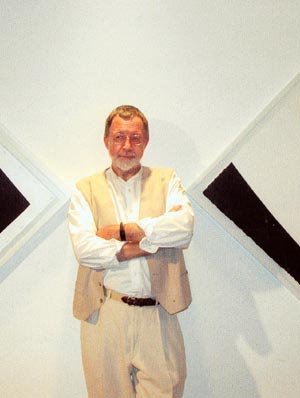
Michael Rodney Tyzack

Michael R. Tyzack

Michael Tyzack is my sixth cousin and below is his obituary.

THE INDEPENDENT – THURSDAY 19TH APRIL 2007 – OBITUARIES – MICHAEL TYZACK

Painter and jazz trumpeter who exchanged Sheffield and London for Charleston, South Carolina.

Michael Rodney Tyzack, painter and teacher: born Sheffield, Yorkshire 3 August 1933; married 1959 Patricia Burgin (one son, one daughter; marriage dissolved 1990), 1993 Anne Carson; died John’s Island, South Carolina 11 February 2007.

Michael Tyzack was one of the most distinguished British abstract painters to have settled in the United States in the last half-century. He went to teach and became a revered mentor for many young artists, telling them that ‘without risk, there is no serious painting’.

Initially Tyzack did not cross the Atlantic to settle, although he had for some time hankered to visit the country whose artists had made such an impact in Europe after the Second World War. When in 1971 he was invited to become visiting artist to the School of Art and Art History at the University of Iowa it was for just two semesters. This was gradually extended until he remained five years before moving to the School of the Arts, College of Charleston, in South Carolina, where he remained as Professor of Fine Arts.

Tyzack said that the transformative event in his career was winning first prize at the fifth John Moores Liverpool Exhibition in 1965, where the jury chairman was the influential American critic Clement Greenberg. Tyzack’s prize picture, Alesso B, was a seductively coloured acrylic on canvas. Although apparently completely abstract, it alluded in its title to the Renaissance painter Alesso Baldovinetti’s Portrait of a Lady in Yellow, in the National Gallery, a reproduction of which was pinned to Tyzack’s studio wall.

Robert Hughes and Norbert Lynton were among other critics to praise Tyzack’s work, Lynton supporting him in his first one-man show at the Axiom Gallery, London, in 1966. The Walker Art Gallery, Liverpool, acquired Alesso B. Asked how he would like viewers to respond to it, Tyzack answered simply: ‘I hope it gives them pleasure.’

Michael Tyzack was born in Sheffield in 1933, only child of Vincent Tyzack, a cutler, and his civil servant wife, Claire. They were proud and encouraging when Mike was enrolled at the Sheffield College of Art and Crafts, then achieved a place at the London University Slade School of Fine Art, gaining his fine art diploma in 1955.

On vacation in Sheffield and lacking a studio, Tyzack heard that the Sitwells’ family seat Renishaw Hall had abundant rooms and outbuildings. He asked for somewhere to paint, and a space was granted. A bonus, Tyzack’s first wife Patzy recalls, was the butler bringing a cup of tea on a tray. More daunting was a visit from the poetess Dame Edith, demanding: ‘Young man, what are you doing here?’

Tyzack had influential teachers at the Slade, among them the Slade Professor William Coldstream, Lucian Freud and William Townsend. In 1956, Tyzack won a French Government Scholarship in Fine Art and left for Paris, later spending time in Menton. Pictures painted in the south showed the influence of Cézanne and a tendency towards abstraction.

While at the Slade Tyzack had met British abstractionists such as Patrick Heron and William Scott and in the move from realism to abstraction he followed the course taken years before by another Slade teacher, Victor Pasmore.

When he returned to England after his stay in France, Tyzack spent several months working as a professional jazz trumpeter. Jazz had been a passion from his youth in Sheffield. He played in bands there and at the Slade, and after marriage in 1959 with his wife visited the London clubs to hear such admired bands as those of Ken Colyer and Humphrey Lyttelton. For two years Tyzack played with the Oriole Jazz Band, a Bristol group that recorded. ‘For Mike it was a serious business,’ says Patzy. ‘He would listen, whereas I thought we were going to dance and leap about.’

As a trumpeter Tyzack admired Louis Armstrong and Bix Beiderbecke, but his jazz interests were catholic. The music informed his painted work, as in the acrylic-on-cotton-duck picture Blue Monk (1982), finished as Tyzack heard of the pianist Thelonius Monk’s death. The sombre blue work reminds us that a psychological, emotional significance underlies its apparent abstraction.

Anyone who knows Tyzack’s mature geometrical abstracts could appreciate his respect for the work of such artists as Malevich and Mondrian. More surprising might be his reverence for those natural celebrators Matisse, especially, and Monet. Tyzack spent his 30th birthday seeking admission to Monet’s garden at Giverny, only to be turned away because it was closed for renovations. Patzy recalls: So he climbed over a wall and lay in the garden among the wistaria and rambling roses drinking his large bottle of champagne. The photographs he took are probably among the last before the renovations took place.

While teaching at such institutions as Cardiff and Hornsey colleges of art, Tyzack continued laying the foundations of a prolific exhibiting career, which would include over 50 British and overseas group show appearances. Among them were ‘Painting Towards Environment’ (Bear Lane Gallery, Oxford, with an Arts Council tour, 1964), ‘New Shapes of Colour’ (Stedlijk Museum, Amsterdam, with European tour, 1966) and the controversial ‘Documenta 4’ (Kassel, 1968). In addition, he had over 20 solo exhibitions.

His first solo show after moving to the US was at the Corcoran Gallery of Art in Washington in 1973 and in 1978 he was given a retrospective at the Frances Aronson Gallery in Atlanta, Georgia. The move to Iowa in 1971 affected the way that Tyzack saw the world, witness his acrylic-on-cotton-duck Nocturne (1972), in the collection of the Indianapolis Museum of Art. Although abstract, it is essentially lyrical and pastoral.

Having spent most of my creative life in dense, crowded urban environments, I seemed to experience the open expansiveness of the sky, as seen for the first time, in Iowa,’ said Tyzack. ‘This spatial expansiveness became incorporated in my paintings.’ He believed that the special quality of light in the Charleston area ‘informs my colour choice almost as much as my emotions’.

A serious car accident in the 1980s led to long and painful months, stretching into years of slow recovery. When he returned to his art, Tyzack exhibited a series of Small Nocturnes, drawings in mixed media on paper. In 1989 he went back to his diamond motif, which had begun with his painting Kremlin (1961). In 2001, it dominated his impressive solo exhibition at the Halsey Gallery, Simons Center for the Arts, in Charleston. ‘Appropriate to the Moment’, a title appropriated from the teachings of Zen Buddhism, comprised 18 works completed between 1989 and 2001. Tyzack’s colour variations were so subtle that sometimes they did not seem to be there. ‘Pessimists see an absence of colour, optimists the potential presence of colour,’ he said.

By now, Tyzack had work in three dozen international public collections, including the Tate Gallery, the Arts Council of Great Britain, the Victoria and Albert Museum, the Gallery of Ontario in Toronto, the Kunstmuseum in Berne, and the Arts Commission of South Carolina, Columbia.

Tyzack retired as head of the College of Charleston’s art department in 2005, when he became Emeritus Professor of Painting. He retained a studio on the campus and continued to teach, where his lust for life, generosity, quintessential Britishness, dry wit and aphorisms were appreciated. When a visiting former student expressed disappointment with graduate school compared with what had gone before, Tyzack wryly commented: ‘You thought it would be Nirvana, but it was bananas.’

Until a few weeks before his death, Tyzack continued to play jazz with his Dixieland band Authenticity. On trips to England he would jam with his guitarist son Ben, who has a recording group, the Spikedrivers.
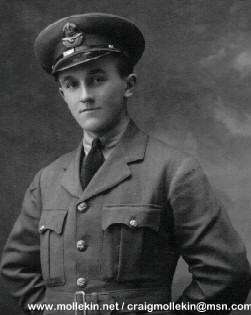
Frank Decent Slingsby

Frank D. Slingsby

Frank Slingsby is my first cousin, twice removed. He died in October 1979 and below is his obituary.

THE MAN WHO DIDN’T WANT TO RETIRE

From a four shilling a week apprentice fitter to chairman of the family company that was the work record of Hull businessman Mr Frank D. Slingsby, who died yesterday at the age of 80.

He was chairman of G. and A. E. Slingsby Ltd. engineers, tube and valve specialists, of Cleveland Street, and had a work record stretching 59 years with the family firm.

Mr Slingsby took control of the firm in 1934 on the death of his father, and became chairman and joint managing director with his cousin when the business was incorporated in 1952.

During the post war years, he also built up a dairy herd of Jersey cattle, and was later joined by his two sons in the family enterprise of F. D. Slingsby and Sons based at Rowlston and Gransmoor.

Mr Slingsby, who lived at Willow Garth Rolston, never considered retiring, and attended his office until April this year.

He is survived by his two sons, Mr David Slingsby, present managing director of the engineering company, and Mr Jeffrey Slingsby, who runs the farming side of the enterprise.

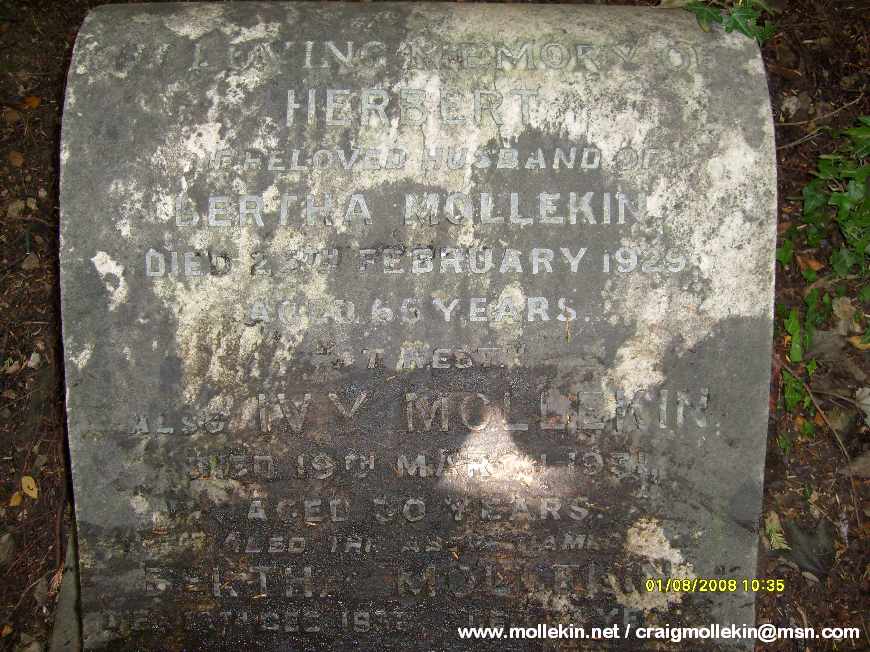
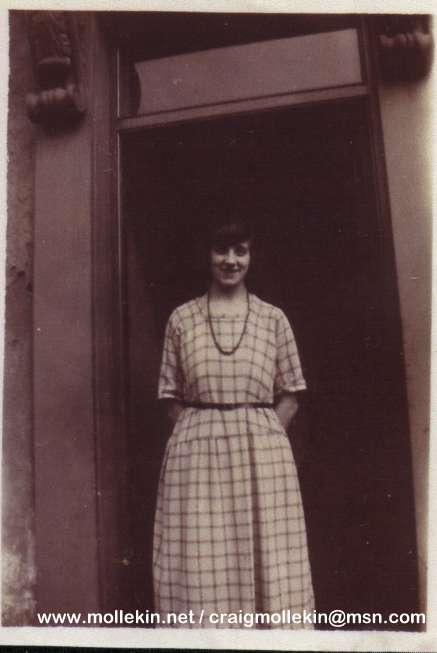
Gertrude Ivy Mollekin

Ivy Mollekin

Gertrude Ivy Mollekin, born in Pontefract, is my first cousin, twice removed and daughter of Herbert Mollekin.

Below is a newspaper article published shortly after Ivy’s death.

ROTHERHAM ADVERTISER – SATURDAY 28th MARCH 1931 – DEATH OF MISS G.I. MOLLEKIN

The death occurred yesterday week of Miss Gertrude Ivy Mollekin, daughter of Mrs. and the late Mr. H. Mollekin, of ‘The Grange,’ Maltby. Miss Mollekin was only 30 years of age.

Prior to the interment, which took place in the Maltby Parish Churchyard on Monday, a service was conducted in the Parish Church by the Rev. H. R. Everson.

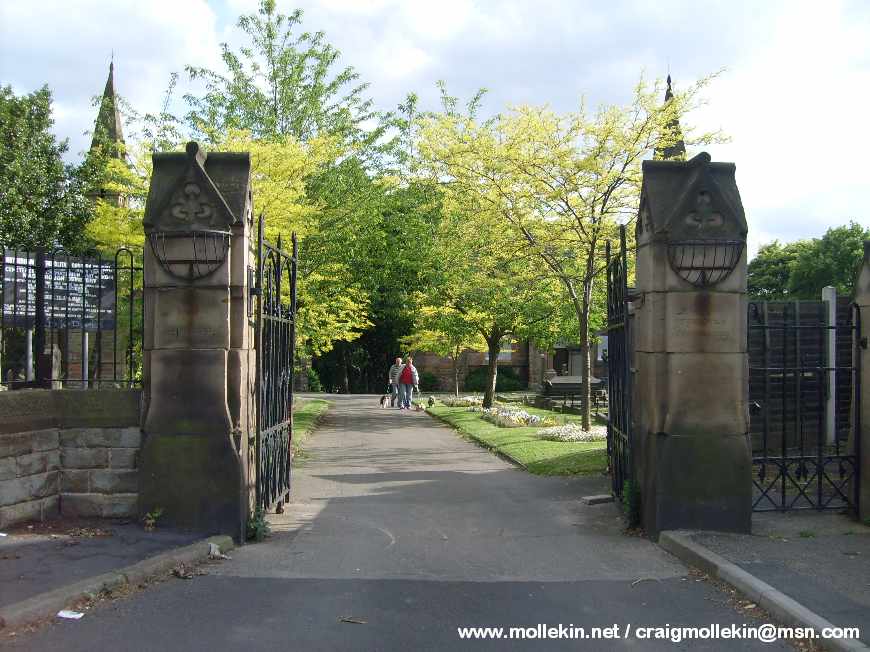
(Grave No. 30) Saint Bartholomew's Church, Maltby (8)

Ivy’s grave

The mourners were Mrs. Mollekin (mother), Mr. and Mrs. G. H. Mollekin (brother and sister-in-law), Mr. and Mrs. E. Mollekin (brother ad sister-in-law), Mrs. Brookes (sister), Mr. and Mrs. McGlade (brother-in-law and sister), Mr. and Mrs. S. Mollekin (brother and sister-in-law), Mr. and Mrs. H. L. Mollekin (brother and sister-in-law), Mr. and Mrs. Stan Mollekin (brother and sister-in-law), Mr. and Mrs. J. Sadler (brother-in- law and sister), Messrs. Claud, Fred, and Jack Mollekin (brothers), Mr. Skinner and daughter (uncle and cousin), Mrs. Pearson (aunt), Mr. and Mrs. J. Mollekin (uncle and aunt), Mr. Morgan R. Jones, Mr. A. J. Booth, Mr. E. Davy and Mr. A. Plant (Sheffield), Messrs. T. Ridgway, M. Wilden, H. Box and E. Shaw acted as bearers. Wreaths and floral tributes were sent by ‘Mother,’ ‘Fred, Claud and Jack,’ ‘Sybil and Jack,’ ‘Mabel and Ernest,’ ‘Harry, Dolly, Basil and Beryle,’ ‘Sid and Lill,’ ‘Dorothy, Ernest and family,’ ‘Uncle Walter and cousins,’ ‘Bert, Daisy, and Herbert,’ ‘Lizzie and Walter,’ ‘Aunt Alice,’ ‘Winnie and Stanley,’ Mr. and Mrs. J. Mollekin, Mr. and Mrs. Fletcher and family, Mr. and Mrs. A. J. Booth, Ald. And Mrs. Dunn, Mr. and Mrs. M. R. Jones, Mr. and Mrs. K. Davy, and Mr. and Mrs. F. Hunter.

Bertha Kennington

Bertha Kennington

Bertha Kennington, born in Hull, is the wife of my great grand uncle, Herbert Mollekin.

Below is a newspaper article published shortly after Bertha’s death.

ROTHERHAM ADVERTISER – SATURDAY 24th DECEMBER 1938 – THE LATE MRS. BERTHA MOLLEKIN

The funeral took place in the Maltby Parish Churchyard on Tuesday of Mrs. Bertha Mollekin, of Blyth Road, Maltby, who died last Friday. The deceased lady, who was 78 years of age, collapsed at her home. A native of Hull, Mrs. Mollekin had resided in Maltby for 34 years. Her late husband was in business there as a master builder up to his death nine years ago. He will also be remembered as a northern racehorse owner. Mrs. Mollekin did not take an active part in local affairs, but she always supported any deserving cause. She had 16 children, and leaves eight sons and four daughters, with 27 grandchildren and one great grand-child. Prior to the interment a service was conducted in the Parish Church, Maltby, by the Rev. W. A. Burtees, who also officiated at the graveside. The mourners included Mr. and Mrs. G. H. Mollekin, Mr. and Mrs. Ernest Mollekin, Mr. and Mrs. Sidney Mollekin, Mr. and Mrs. Stanley Mollekin and Mr. and Mrs. Jack Mollekin (sons and daughter-in-law), Mr. Fred Mollekin and Mr. Claud Mollekin (sons), Mr. and Mrs. E. J. McGlade, Mr. and Mrs. H. Nicholson, Mr. and Mrs. J. Sadler and Mr. and Mrs. H. Brooks (sons-in-law and daughters), Mrs. Pearson (sister), Mr. and Mrs. J. Mollekin (brother-in-law and sister-in-law), Mr. Frank Hunter (who had worked with Messrs. Mollekins for about 50 years), Mrs. E. Davy, Mrs. Harris and Mrs. E. Dunn. Messrs. Barker C. White, Stables, E. Davy and T. Ridgeway represented the workmen of Mollekin Bros., and Messrs. Firth and W. Godber the firm. Messrs. Morgan R. Jones (Surveyor) and Mr. R. Oddy (Sanitary Inspector) represented the Maltby Urban District Council. Others present were Mr. Charles Stevens, Mr.

Bertha’s Grave

George Brown, Mr. Sadler of Sandbeck, Mr. and Mrs. Barlow, Mrs. T. Holdsworth, Mr. A. J. Booth, Miss Franks and Mrs. Davies. Floral tributes were sent by ‘Dolly, Harry and children,’ ‘Fred and Claude,’ ‘Harry, Ada, Polly and Derrick,’ ‘Mabel and Ern,’ ‘Jack and May,’ ‘Stan and Winnie,’ ‘Jack and Gilbert,’ ‘Sybil, Jack and Betty,’ ‘Ernest, Dorothy and grandchildren,’ ‘Bertie, Daisy and Herbert,’ ‘Sid, Lil and children,’ ‘Alice Pearson,’ Mr. and Mrs. E. Dunn, ‘Hatty,’ ‘Lauri Steeples,’ George Smith, chairman and members of the Maltby Urban District Council, Mrs. Harris, Mr. and Mrs. Whitley and family, Mr. and Mrs. F. Hunter, Maltby workmen of Mollekin Bros., Cannock workmen of Mollekin Bros., E. Butler and Sons, ‘Aunt Annie and Uncle Jack,’ Mr. and Mrs. T. White, ‘Thomas and Charles,’ Mr. and Mrs. E. Davy, ‘W. Godber,’ Mr. and Mrs. F. Pearson and family, Mr. and Mrs. J. T. Downing and family, Mr. and Mrs. J. T. Downing, of Sheffield, Mr. and Mrs. J. C. Stevens, Halliday and family, Mrs. Bootman, Mr. and Mrs. T. Houldsworth etc. The relatives of the late Mrs. B. Mollekin wish to thank the doctor for his kindness to Mrs. Mollekin during her illness, also those who sent kind messages of sympathy and floral tributes during their great bereavement.

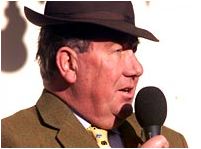
David Nicholson – The Duke

David Nicholson

David Nicholson is my third cousin and the grandson of Herbert Mollekin. David was a renowned horse trainer and the newspaper article below gives an insight into his life and achievements.

THE DAILY TELEGRAPH – TUESDAY 29TH AUGUST 2006 – OBITUARIES – NATIONAL HUNT TRAINER WHO SENT OUT SOME 1,500 WINNERS AND NURTURED SOME OF OUR FINEST JOCKEYS

DAVID NICHOLSON, who died on Sunday aged 67, was one of the most successful National Hunt trainers of his era.

Known to all as ‘the Duke’, Nicholson sent out 1,499 winners during his 31 years as a trainer; earlier in his career he had enjoyed success as a jump jockey.

There was never much doubt that David Nicholson would make his life in horse racing. Born at Epsom on March 19 1939, he was the son of Frenchie Nicholson and his wife Diana.

Frenchie had been a joint champion jump jockey before becoming a successful trainer based in Cheltenham; his training establishment was known as the ‘Frenchie Nicholson Academy for Riders’ in tribute to the number of successful jockeys produced there; they included Pat Eddery, Walter Swinburne and Tony Murray. Diana Nicholson was the daughter of the Cheltenham trainer William Holman.

David was educated at Haileybury, but from the age of 12 he rode as an apprentice to his father. He remained in that role until 1960, and was a professional jump jockey until 1974. He once said that he had deliberately volunteered to ride bad horses because he enjoyed ‘getting the buggers round’.

Nicholson rode 583 winners as a jump jockey; and although he never finished higher than third in the jockeys’ table, he had some fine wins to his credit. He won the Whitbread Gold in 1967 on Mill House; the Imperial Cup in 1960 on Farmer’s Boy; the Cathcart Chase (1962, on Hoodwinked); the Schweppes Gold Trophy (1965, on Elan); and the Champion Chase in 1971 on Tantalum. His last winner was aboard What A Buck, on April 3 1974 at Hereford. In 1961 he had bought Cotswold House, at Condicote, in Gloucestershire, and in 1968 he had taken out a license to train. His first winner as a trainer came with Artic Coral, at Warwick on January 9 1969, but his new career was slow to take off. It was not until the early 1980’s, when there was an influx of faster, Flat-bred horses, and when he had the riding services of Peter Scudamore, that he really began to make his mark.

Nicholson’s greatest moment as a trainer was undoubtedly winning the Gold Cup with Charter Party in 1988; but he won many other high class races at Cheltenham Festival. These included the Triumph Hurdle (in 1986 with Solar Cloud, and in 1994 with Mysilv); the Arkle Challenge Trophy (1989, Waterloo Boy); the Queen Mother Champion Chase (1994 and 1995, with Viking Flagship); and the Stayers’ Hurdle (1999, Anzum).

He had other big-race successes too, among them the Sean Graham Hurdle with Broadsword in 1981; the Mackeson Gold Cup, in 1986 with Very Promising, and in 1991 with Another Coral; and the king George VI Chase in 1993 with Barton Bank. He also won two Scottish Grand Nationals (Moorcroft Boy in 1996, and Baronet two years later).

Nicholson’s career was not without its setbacks, however. By the late 1980s his training operation was experiencing financial difficulties, and he was fortunate to be invited to move, in October 1992, to the purpose-built, 80-box Jackdaws Castle, in Gloucestershire, developed by a retired construction engineer, Colin Smith. Smith installed Nicholson as a salaried trainer with a renewable five-year contract; he also looked after the business side, leaving Nicholson to give all his attention to the horses.

This arrangement proved a great success. In his first season at Jackdaws Castle Nicholson sent out 100 winners, at that time only the fifth jumps trainer since the war to do so.

Nicholson was champion National Hunt trainer in 1993-94 and 1994-95. His innate gifts as a trainer were augmented by a talented procession of stable jockeys. Among them Peter Scudamore (1980-86), Richard Dunwoody (1986-93), Adrian Maguire (1993-99) and Richard Johnson (1999).

Nicholson prized loyalty and good sportsmanship. A traditionalist who retained great respect for the old steeplechasing days, he was a stickler for correct dress. He held strong views and was never reluctant to speak his mind; when wishing to make a point forcibly, he would jab his finger into his interlocutor’s chest. One of his admirers, the racing commentator Alastair Down, once conceded: ‘He was never going to be a loss to the public relations industry.’

In 1995 he was fined £1,500 by the Jockey Club Disciplinary Committee following a confrontation with a photographer at Kempton Park; after the hearing Nicholson remarked: ‘It’s a stiff fine, but nothing a large brandy wouldn’t cure.’

Asked 10 years ago how he would like to be remembered, Nicholson replied: ‘A good tutor of jockeys, a good schooler of horses and a hard bastard.’ He was a convivial man who enjoyed celebrating his wins with a ‘serious glass’. At a jockeys’ ball in 1970 he threw a raw egg, inadvertently hitting Mrs Frank Osgood, wife of the clerk of the course at Newbury, on the side of the face. He apologised in a telephone call and sent her a bunch of flowers.

A great cricket enthusiast, he was a member of MCC.

Nicholson published an autobiography, The Duke, in 1995, and retired from training in 1999. In March 2002 he was appointed the British Horseracing Board’s bloodstock representative, responsible for promoting British-bred horses at home and abroad.

David Nicholson married, in 1962, Dinah Caroline Pugh, whom he usually referred to as ‘mother’; they had two sons.

RACING – NATIONAL HUNT LEGEND ‘THE DUKE’ DIES AT 67

DAVID NICHOLSON, leading jockey and championship trainer, man of the Old School and racing ambassador, who has died, aged 67, was truly a National Hunt legend, one of whose involvement in the sport spanned a lifetime.

Nicholson was universally known as ‘The Duke’. His trademarks were red socks, sheepskin coat, and the stubborn approach of one moulded by the strict regime of a famous father and a desire to succeed in a tough game about which he was passionate.

The stab of the right index finger into the chest of a listener most definitely made Nicholson’s point in conversation, but he also left his mark in countless other ways. Partnering 583 winners over 20 years as a jockey, two trainers’ titles, success in the Cheltenham Gold Cup, two Queen Mother Champion Chases, and being part of the famous Jackdaws Castle training complex from scratch, were well-known achievements.

Also, the influence on young men who were to make their names as jockeys, including Peter Scudamore, Richard Dunwoody, Adrian Maguire and Richard Johnson, as well as Alan King, a rising star in the trainers’ ranks. And then there was his tutoring of the Princess Royal on the finer points of riding under Rules. He was also particularly proud that he had given around 100 jockeys their first race rides.

But the story that is not quite as well known was Nicholson’s lifelong fight for survival after first displaying the symptoms of asthma when only six months old. Allergies (including one to horses) afflicted him in childhood to the extent that milk, eggs, fish, jelly and fat were cut out of his diet, and his mother kept a nightly vigil as he was continuously wheezing as he slept.

A series of terrifying asthma attacks in childhood left him close to collapse, yet he was determined to be a jockey and pestered his father, the trainer (and ex-jockey) Frenchie Nicholson, so much that his first race ride came in the Brandon Apprentice Plate at Newmarket in 1951 when he was barely 12 years old.

Those, who knew The Duke only in his latter years would be surprised to learn that he tipped the scales that day at a mere 4st 7lb and needed to carry another 4st in dead weight to reach the required 8st 9lb of his mount Fairval. ‘My hands were in such a muddle, I nearly poked my eye out trying to hit the poor horse – and I was too weak to carry back the saddle,’ he was to recall.

His only winner on the Flat came at an evening meeting at Wolverhampton when, riding a horse called Desertcar, he beat Lester Piggott into second. He described it as ‘a pretty humdrum race.’ Soon after, he was to concentrate entirely on jumping.

King, who was The Duke’s assistant for many years before taking out his own licence, said: ‘He had such a love for the support and he leaves behind so many legacies.’

Trainer Nicky Henderson said: ‘He was a larger-than-life man who gave everything to racing. He became a great friend and everyone respected him.’

Dunwoody, who partnered Charter Party to Nicholson’s most famous win as a trainer, in the 1988 Gold Cup, said: ‘He was a fantastic boss.’

Nicholson retired from training in 1999 and soon enthusiastically embraced a new position specially created for him by the Thoroughbred Breeders’ Association, that of roving ambassador.

He was a Deauville for the important sales weekend only nine days ago. Braving the elements – it had been lashing rain most of the weekend – The Duke appeared in the winner’s enclosure after the running of the Group One Prix Morny, won by Paul and Susan Roy’s Dutch Art. Beckoning me closer, the finger wagged in proclamation: ‘Don’t forget, the winner is British-bred.’

This post was originally published on Mollekin Portalite on 12/10/2011.

Halliday Crompton

Halliday Crompton

Halliday Crompton, born in 1889 in Bury, is the husband of my first cousin, twice removed, Bertha Lily Mollekin.

It is interesting to note that Halliday is a distant relation of the authoress, Richmal Crompton, who authored the ‘Just William’ books.

BURY TIMES – 10th JANUARY 1948 – MR. HALLIDAY CROMPTON

The death took place suddenly in Bury Infirmary on Thursday of Mr. Halliday Crompton, of 102, Walmersley-road. He was 58 years of age.

Mr. Crompton, who was the second son of the late Mr. W. W. Crompton, a Bury solicitor, and brother of the late Mr. Alfred and Mr. Neville Crompton, also well-known solicitors in the town, was educated at Giggleswick School. He took to farming as a career, living at Waddington, near Clitheroe, until his wife died, 20 years ago, when he returned to Bury.

One of the last events he was able to attend was the marriage of his youngest daughter at St. Peter’s Church, Bury, three weeks ago.

Mr. Crompton was a member of the Trevelyan Club for a long number of years and was also associated for many years with the Central Conservative Club.

At one time he was a representative of Mr. William Crompton, chemist, of Bolton-street, and before his retirement was assistant to Mr. Frank Butterworth, auctioneer and estate agent, of Bury.

He leaves two sons and four daughters.

The funeral will be at Waddington Parish Church at noon on Tuesday.

This post was originally published on Mollekin Portalite on 10/10/2011.

Luke Berry

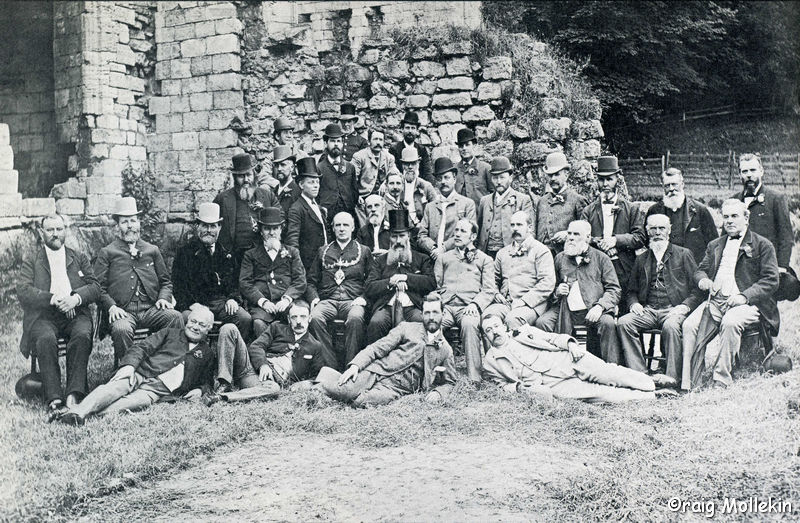
Luke Berry - Roche Abbey, Maltby - 1889

Luke at Roche Abbey

Luke Berry is my third great grandfather and he was born in 1823 in Kexborough, Barnsley. In 1845, Luke married Jane Walker.

Luke and Jane issued seven children, four of which did not survive infancy; three succumbed in quick succession during the 1860s from Scarlet Fever. The surviving children were, Hannah Berry (1845 to 1924), Agnes (1847 to 1916) and Priscilla Walker (1852 to 1918). Hannah is my second great grandmother and she married Francis Pinder in 1867.

In the 1850s, Luke and Jane moved to live in Rotherham, where they remained. Luke died in 1891 and Jane in 1897. Their headstone still survives in Moorgate Cemetery, Rotherham, but has now toppled over and the inscription is no longer visible.

frederick-street-rotherham-copyright-colin-leonard-1965-1

Rotherham Waterworks

THE ROTHERHAM ADVERTISER – SATURDAY 19th DECEMBER 1891 – DEATH OF MR. L. BERRY, OF ROTHERHAM

We regret to have to record the death of Mr. Luke Berry, which took place at his residence, the Waterworks, Frederick Street, Rotherham, on Saturday evening. The deceased gentleman was 68 years of age. He had not been thoroughly well since June last, when he had the misfortune to be thrown out of a trap on his way to Ulley Reservoir. On that occasion he received a severe shock, and his heart had been in weak state ever since. However, he had only been confined to the house for about three weeks and was downstairs a few days before his death. Dr. Baldwin had been his medical adviser, and recently, Dr. Dyson, of Sheffield, was consulted. The cause of death was angina of the heart, coupled with an asthmatic condition.

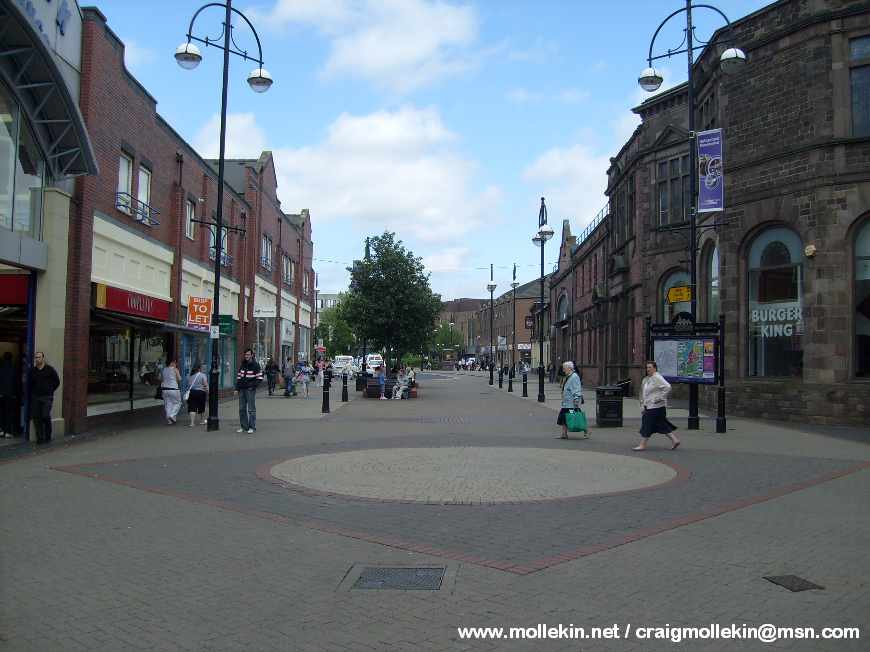
Frederick Street, Rotherham - 28.05.09 (3)

Frederick Street

Mr. Berry was a native of Kexbro’, near Barnsley. In his younger days he was engaged at Taylor’s Mills, Redbrook, and subsequently he was employed at Mitchell’s Ironworks, Worsbro’ Dale, as engine fitter and pattern maker. After a few years in that position he proceeded to the Kirkstall Forge, Leeds, belonging to Messes. Beecroft and Butler. It was at these works that the large engines at the Waterworks were produced. Mr. Berry had worked himself into a position of trust, and amongst other places visited Germany on the firm’s account. When the engines were erected at Rotherham, he had the management of the work, and as was customary with the firm with which he was identified, he stayed six months after their completion to see that all the work was in proper order. At the completion of that period the Local Board of Health secured his services as resident manager and engineer, a position which he retained for a period of 36 years.

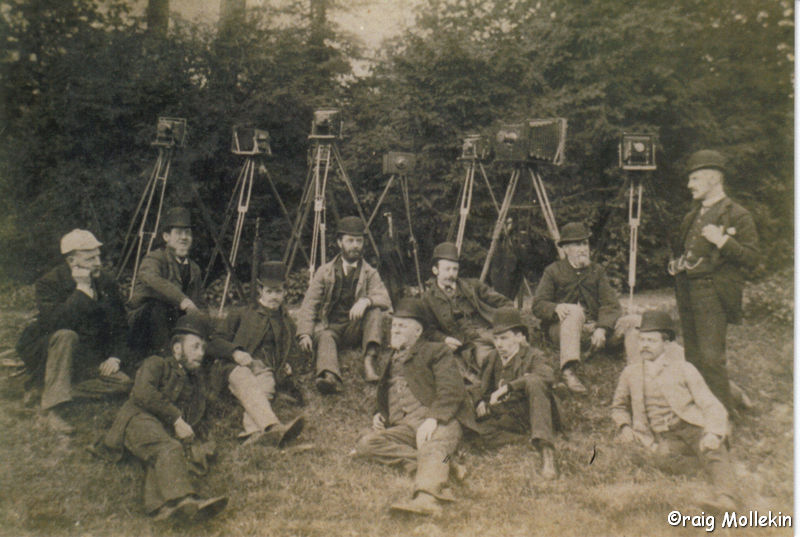
Luke Berry - Roche Abbey - Circa 1889 (Copyright Liz Early)

Luke at Roche Abbey

Mr. Berry followed many scientific pursuits, and the observatory in the yard adjoining the house was an indication of the manner in which his mind was bent. Chemistry may be said to have been his favourite science, especially analysis, and he was able to test water and other liquids in a practical way. His apparatus shows he spared no expense in the acquisition of knowledge not only for the purposes of his profession, but also for his amusement. He constructed a valuable telescope, and also a sidereal timepiece, to and him in astronomical studies. At the time of his advent to Rotherham he made an organ. This instrument was used on one occasion at the Mechanics’ Hall, when an oratorio was performed. The organ was afterwards sold to Dr. Sewell, then organist of the Parish Church, and later it came into the possession of the Rev. Dr. Falding, and was used at the old Independent College, in College Road, Masbro’.

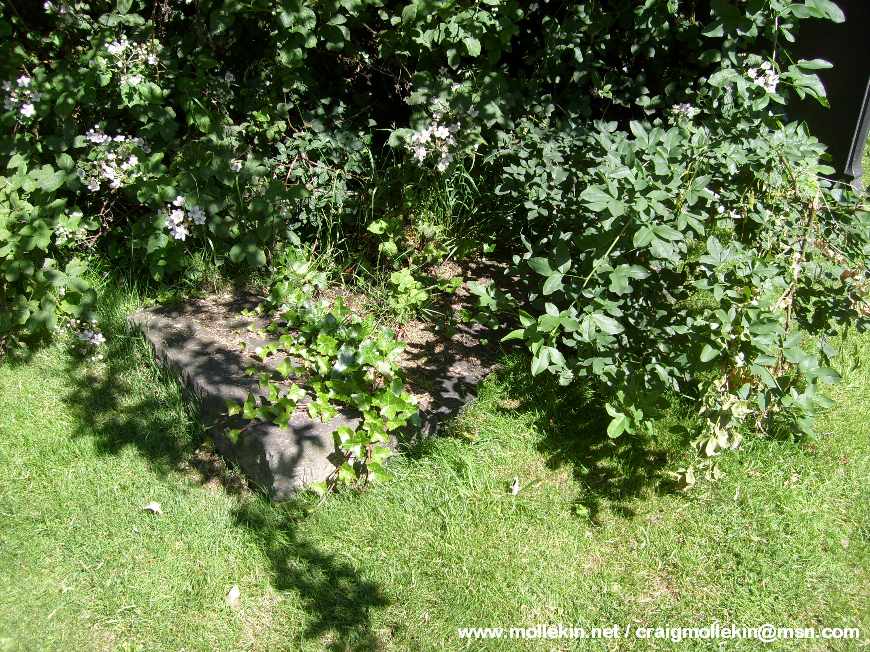
(Grave No. 69) Moorgate Cemetery, Rotherham - 24.06.09 (2)

Berry grave

Mr. Berry was fond of the microscope, and devoted some attention to photography, being a member of the council of the Rotherham Photographic Society, and also of the Rotherham Naturalists’ Society. Electricity found in him an earnest student. He introduced a system of electrical indicators, by which he could ascertain the depth of stored water at the reservoirs. He brought out several patents, one being a smoke consumer which is in use at the works at the present time. About twelve months ago he introduced a method by which two large boilers would do the work which four used to do, and saved something like £50 per month in fuel alone. As an organiser, his tact was clearly demonstrated in 1886, when there was a famine. For years he contended that Dalton was a necessity, the supply at Ulley, Pinch Mill, &c., not being adequate in the case of a continued dry period. The force of this brought home to the opponents of the scheme by the night and day labour which had to be done in a time of drought, to secure the use of the Dalton water. Mr. Berry took little or no part in politics although his views had a Conservative tendency.

For many years Luke was a local preacher in the Wesleyan Methodist denomination, first being identified with Talbot Lane and latterly with Eastwood Chapel. The deceased gentleman was held in great respect, and his demise is regretted by a large circle of friends. He leaves a widow and three daughters, viz, Mrs. F. Pinder, Mrs. J. Early, and Mrs. Brelsford.

Moorgate Cemetery, Rotherham - 13.07.09 (4)

Moorgate Cemetery

The interment took place at the Rotherham Cemetery, on Thursday, the officiating minister being the Rev. A. Westcombe. The mourners were Mrs. Berry, Mr. and Mrs. F. Pinder, Mr. and Mrs. J. Early, Mr. and Mrs. Brelsford, Mr. Mark Berry, Senior, Sheffield; Mr. Mark Berry, Junior; Mr. and Mrs. A. Price, Master Harry, the Misses Edith and Beatrice Pinder, Mr. W. A. Brelsford, Mr. Geo. A. Early, Mr. Walter Early, Barnsley; Mr. F. A. Early, Mr. Ernest Early, Mr. Jno. Walker, Barnsley; Mr. and Mrs. Geo. Wilson, Mr. J. Wilson, Miss Wilson, Hoyland; Mr. Herbert Walker, Miss S. A. Walker, Miss L. Walker, Miss M. A. Pinder, Mr. Palfreyman, and Mr. W. Crabtree, Doncaster. The members and officials of the Corporation followed in seven carriages. There were present Alderman Wragg, and Councillors F. Mason, G. Gummer, J. Pearce, T. Charles, J. Chesterfield, J. Cox, E. Hickmott, D. L. Winter, J. B. Habershon. The Mayor (Councillor W. L. R. Hirst) had written expressing his regret that he should be prevented by another engagement from attending the funeral. The Town Clerk (Mr. H. H. Hickmott) was unavoidably absent in consequences of having to be present at an important mining inquiry at Sheffield. The borough officials present were Mr. C. H. Muss (sic), borough accountant; Mr. E. Cooper, borough collector; Mr. G. J. Thurgarland, assistant to Town Clerk; Mr. J. Enright, chief constable; Mr. T. Bellamy, gas secretary; Mr J. Taylor, baths manager; Mr. H. Albiston, park keeper; Mr. E. C. May, park keeper; Mr. O. E. Parkin, sanitary inspector; Mr. H. J. Wright, stores keeper; Mr. J. Goodwin, gas manager; and Mr. W. Law, deputy market inspector. Wreaths had been forwarded by employees of the Waterworks, the officials of the Corporation, and from members of the family.

This post was originally published on Mollekin Portalite on 29/06/2011.

Herbert Mollekin

Herbert Mollekin (centre)

Herbert Mollekin (centre)

Johann Hermann Mölleken (known as Herbert Mollekin) is my great grand uncle and was born in Sunderland, in 1863, to parents, Johann Mölleken and Henriette Muehlenweg.

In 1888, Hebert married Bertha Kennington in Hull. Together, they issued sixteen children, who were called, George Herbert (1889 to 1970), John Ernest (1890 to 1974), Bertha Lily (1892 to 1927), Harold (1893 to 1893), Alice Ada (1894 to 1942), Harry Leonard (1896 to 1976), Mabel (1897 to 1974), Dorothy May (1898 to 1970), Albert Sydney (1899 to 1976), Gertrude Ivy (1901 to 1931), Stanley (1902 to 1989), Sybil (1903 to 1993), Edward Arthur (1904 to 1904), Norman Frederick (1906 to 1990), Claude (1908 to 1968) and Jack Everatt (1910 to 1963).

Herbert was a prolific house builder and was considered to be a good employer by his workers. Further details regarding Herbert’s building activities can be read here.

Below is a newspaper article which gives an insight into Herbert’s life and achievements.

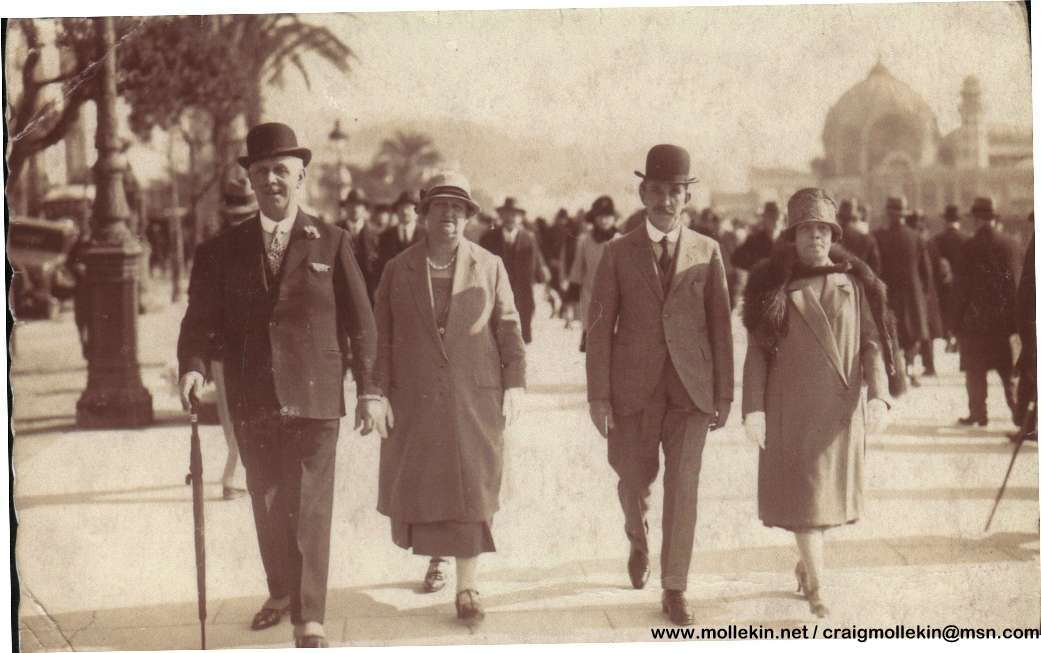
Herbert Mollekin in Nice (left)

Herbert & Bertha in Nice

ROTHERHAM ADVERTISER – SATURDAY 2ND MARCH 1929 – MR H. MOLLEKIN –

DEATH OF WELL KNOWN MALTBY CONTRACTOR

TURF SUCCESS

The death took place in a Sheffield nursing home on Monday night of Mr. Herbert Mollekin, of The Grange, Maltby. He had been in a critical condition for some days.

The news of Mr. Mollekin’s death caused profound regret throughout South Yorkshire, for he was well known both as a builder and a Turf personality. A typical self-made man, he started his career as a working joiner, his energy and enterprise winning for him an enviable position in the building industry. The firm of Mollekin and Sons may, in fact, claim to be one of the largest building contracting firms in the district. He was a Northerner, but spent the greater part of his early days in Hull and Pontefract. Leaving joinery and becoming a bricklayer, he went to Pontefract, where he first worked as a builder.

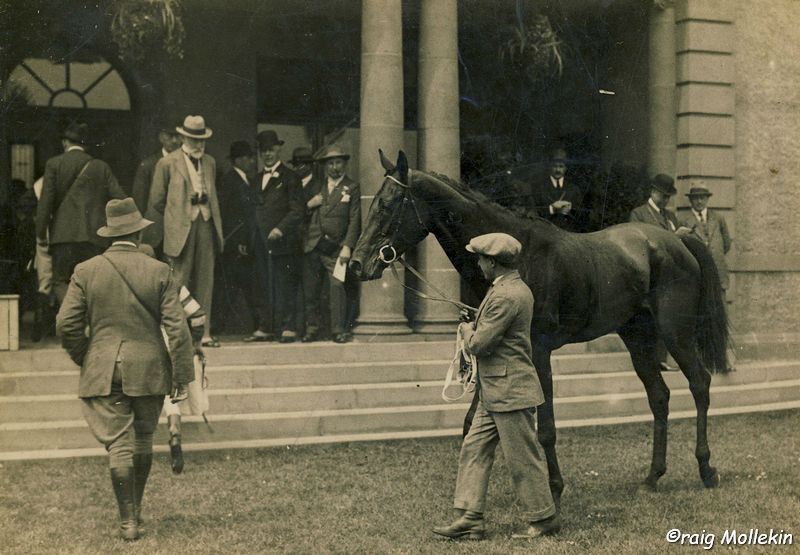
Hebert at the Doncaster Races with the Earl of Scarborough

Hebert at the Doncaster Races with the Earl of Scarborough

It is now over twenty years since he went to Maltby and carried on his trade, his business enterprise being eventually rewarded. He always took a keen interest in Maltby, both as a business man and as a resident. He was virtually responsible for the rebuilding of practically the whole of Maltby, and there are many other mining villages throughout a wide area which have developed municipally under his hand. He started about 1910 to build the model village at Maltby, and although the progress of the scheme was impeded by the War, Mr. Mollekin took it up again afterwards. When sinking operations commenced at Thurcroft about the year 1913, he secured building work there, and again achieved the distinction of establishing almost an entirely new village.

He also built Rhodesia village, near Shireoaks; Council houses at Rawmarsh, Thurcroft, Blackwell, and South Normanton. Other contracts executed by him included the new elementary school at Thurcroft, the Technical Institute at Dinnington, and the new-type elementary school at Bramley.

Herbert Mollekin (right)

Herbert Mollekin (right)

PROMINENT TURF PERSONALITY.

Mr. Mollekin was also widely known through his career on the Turf. His association with Melton Vasey, his trainer and chief advisor, was a most satisfactory one, although it commenced only in 1922, when he made his debut as an owner. He was a very popular figure at all the northern meetings, and particularly at York, Manchester, Pontefract, Ayr, Newcastle and Redcar. At all these he had taken valuable prizes, and although he was not so successful at Doncaster, he was always well represented at all three meetings. He and Melton Vasey did a great deal to establish training in Doncaster and to increase its importance as a centre, apart from it’s importance as a meeting place. He commenced in a very modest style in the sport which claimed his undivided enthusiasm. He followed his horses wherever they were and the success of his first purchases, Balzac and Pickwell encouraged him to extend his operations. While he never gave a great amount of money for his horses, he and his trainer had a remarkable knack of picking up things cheaply. One of his most prolific winners was Miss Connie, which he purchased at the Doncaster September sales for £100 and which won him in stakes something like £5000, including the Old Newton Cup at Haydock Park and a £1000 race three years ago. The horse, Amazement also proved a successful investment, for he bought it out of a selling race at Doncaster and it afterwards took the Gosforth Park Cup and the Carlton Handicap. King Willow came very close to taking the season’s first big race at Lincoln several years ago when it ran 3rd to Tap in. It will be recalled that five years ago a number of horses at Belle Vue got loose, including a number of Mr. Vasey’s charges, King Willow being rather badly kicked, while another, Soval, upon which Mr. Mollekin and Mr. Vasey had set high hopes, was badly injured. Foul play was suspected and the affair caused a remarkable sensation in racing circles. It was always thought that someone had deliberately set the horses loose. Mr. Mollekin offered a substantial reward, but the culprit or culprits were never traced.

The Grange

The Grange

KEEN PERCEPTION.

Keen perception was illustrated in the purchase of Mr. Vasey, on behalf of his patron, of four yearlings at the Newmarket Sales. Abbott’s Luck, which cost 100 guineas; Abbott’s Son, 80 guineas; Corn Sheaf, 60 guineas; and Tracite, 35 guineas. All won races. Abbott’s Luck taking the Corby Plate, worth £500, at Carlisle, and a £1,000 race at Manchester.

Other of his horses which did well were French Martin, Bold Wase, Poet’s Dream, Savage Lass, Rock Ruby, Battery Smoke, Baalbeck, and Balglick, while Dryhead, bought out of a seller, won the Batthyany Stakes, worth £500, at Lincoln. Hard Rock, which Mr. Mollekin bred himself, was his nomination for this year’s St. Leger, and had already been well spoken of. Noctiluce was still another good winner; while Great Speech also took first place several times. Last season Silver Castor, which cost only £50, won three good races.

Mr. Mollekin took a keen interest in his Tickhill Stud, where he had a number of good class animals in training.

Broomhall Place

Broomhall Place

Six of Mr. Mollekin’s sons are engaged in the business, one of them, Mr. Jack Mollekin, spending a short time under Mr. Vasey but increasing in weight put an end to his competitive riding. Mr. Jack Mollekin is now in charge at Tickhill.

Mr. Mollekin also leaves six daughters.

THE FUNERAL.

The funeral took place at Maltby yesterday. Prior to the interment in the Maltby Churchyard, there was a service in the church, conducted by the Rev. H. R. Everson (Vicar).

Ivy's grave

Herbert’s grave

The family mourners were Mrs. Mollekin (widow), Mr. and Mrs. G. H. Mollekin (son and daughter-in-law), Mr. and Mrs. E. Mollekin (son and daughter-in-law), Mrs. H. Nicholson (daughter), Mr. and Mrs. E. McGlade (son-in-law and daughter), Mr. and Mrs. Harry Mollekin (son and daughter-in-law), Mr. and Mrs. H. Brooks (son-in-law and daughter), Mr. and Mrs. Stanley Mollekin (son and daughter-in-law), Mr. and Mrs. Sidney Mollekin (son and daughter-in-law), Miss Ivy Mollekin (daughter), Mr. and Mrs. J. R. Sadler (son-in-law and daughter), Messrs. Fred, Claude and Jack Mollekin (sons), Mr. Jack Mollekin (brother), Mr. and Mrs. Skerrow (brother-in-law and sister-in-law), Mrs. Pearson (sister-in-law), and Mr. H. Crompton (son-in-law). Others present were Mr. Joe Taylor (stable jockey), Mr. Melton Vasey (trainer), Mr. T. Frost (Bawtry), Mr. Herbert Fox (Doncaster), Messrs. J. T. Downing and K. Downing (Sheffield), Mr. Chas. Farrar of Doncaster (representing the West Riding County Council Education Architects’ Department), Mr. C. N. Hodgson (Rotherham), County Alderman E. Dunn, J. P. and Mr. Hugh Ross (representing the local branch of the Yorkshire Miners’ Association and the Maltby Urban Council). Mr. F. Roebuck (clerk to the Council), Mr. M. R. Jones (surveyor) and Mr. R. G. McNaught (assistant surveyor), Mr. H. C. Harrison (representing the Doncaster Rural District Council), Messrs. H. Barnard, G. Fitton, and E. Nelson (Tickhill stud employees), Messrs. E. H. Lockwood (representing the Maltby Show Committee), Mr. T. Fawcett (Doncaster), Mr. and Mrs. T. B. Buckley (Maltby), Mr. F. Lidgett, Dr. E. E. Dufty, Mr. and Mrs. R. P. Marsh, Mr. G. H. Ashforth (Rotherham Builders’ Supply Co.), Mr. George Fox (Yorkshire Amalgamated Products), Mr. W. Catchpole (Maltby Metallic Brick Co.), Mr. Gilbank (gardener at The Grange), Messrs. E. Raper, A Fisher, and A. Stables (representing the Maltby Cricket Club), Messrs. H. Cutts and C. Daniels (Maltby Salvation Army). A large number of employees of the firm of H. Mollekin and Sons also attended, among them being Mr. F. Hunter the oldest workman who has been with the firm for thirty years. Messrs. J. Beeden, G. Lawrence, J. Wrigley, B. Reid, G. F. Clarkson, W. Goodacre, H. Wingfield, M. Wilding, N. White, F. P. Arker, H. Box, R. Longbottom, G. Smith, J. Wood, G. Brown, and T. Hunter. Wreaths were sent by the following, Mrs. Mollekin and children, Mr. and Mrs. Sadler, Mr. and Mrs. Skerrow, Mr. and Mrs. Pearson, Mr. H. Crompton and grandchildren, Mr. and Mrs. A. J. Booth, Mrs. Brooks, Mr. and Mrs. R. P. Marsh, Mr. C. Chambers, Dr. and Mrs. Dufty, Mr. and Mrs. T. Fawcett, Mr. and Mrs. J. Crowther, Mr. and Mrs. Melton Vasey, Mr. and Mrs. J. Taylor, Mr. and Mrs. Longbottom, Mr. and Mrs. Thompson and family, Mr. and Mrs. Hunter, Ald. And Mrs. Dunn, Mr. and Mrs. Doyle, Mrs. A. H. Brown, Mr. and Mrs. Booth (Worksop), Mr. and Mrs. Armstrong, Mr. and Mrs. Middleton, Mrs. Berwick, Mr. Stoepling and family, Mrs. Morgan and children, Maltby Branch of the Y.M.A., Directors of the Maltby Metallic Brick Co., Yorkshire Amalgamated Products Limited, Maltby Show Committee, staff of the Tickhill Stud Farm and the employees of Messrs. H. Mollekin and Sons.

This post was originally published on Mollekin Portalite on 15/06/2011.

Kicked in the neck

Masbrough Cemetery

Amelia Pinder, born in 1868 in Rotherham, is my great grand aunt and daughter of Francis Pinder and Hannah Berry.

In 1891, in Rotherham, Amelia married Alfred Thomas Price and together they issued four children, called, Ernest Alfred, Reginald, William Cecil and Charlotte Grace.

As a child, I remember my father telling me a story that had been told to him by his father about how in Wickersley, a Milkman called Les Birkett was kicked in the neck by a horse and subsequently died. I later discovered that Les Birkett was quite closely related to my family and according to the 1925 edition of Kelly’s Directory for Rotherham had his milk business registered on Fitzwilliam Road. However, I also discovered that Les Birkett didn’t die until 1975 aged 79 in Scarborough, so he almost certainly didn’t die as a result of being kicked by a horse on his milk-round.

Whilst reading the Rotherham Advertiser dated, Friday 27th May, 2011, I came across an article in the ‘100 years ago’ section which suggests that there may have been some truth in my father’s tale regarding somebody getting kicked by a horse and dying.

ROTHERHAM ADVERTISER
SATURDAY MAY 27, 1911
A tragic occurrence, resulting in the death of Mr. Alfred Thomas Price, Gavenny, Kimberworth, a well-known tradesman and a partner of the firm of Stenton and Price, glass and china merchants, Wellgate, took place on Monday. Mr. Price was attending to the horse, used for business purposes, when it became troublesome and he received a kick to the neck and died almost immediately. The inquest was held on Tuesday afternoon in the Kimberworth Wesleyan Schoolroom by the Deputy District Coroner (Mr. J. Kenyon Parker). Evidence of identification was given by the wife of the deceased, Amelia Price, who last saw him alive shortly before nine on Monday morning. He was going to the stable at the Effingham Arms, Bradgate, to put the horse in the tub. At a quarter past nine she saw her husband dead at the public house.

Alfred was buried in Masbrough Cemetery on, 25th May 1911.

Amelia died in October 1924 and was also buried in Masbrough Cemetery, on 17th October 1924, presumably with Alfred. There is no surviving headstone.

THE ADVERTISER, SATURDAY, OCTOBER 18, 1924

PRICE. – At “Gavenny,” Kimberworth, Oct. 14, Amelia Price, widow of the late Mr. A. T. Price, and daughter of Mr. Francis Pinder, aged 57, after many years of suffering died peacefully at the end. “Peace, perfect peace.” The interment took place Masbro’ Cemetery, Oct. 17.

The family of the late Mrs. Price thank all friends for their sympathy and kindness shown towards them during their loss.

The location of Alfred’s death, The Effingham Arms, is still standing in Bradgate and can be viewed in Google Street View by clicking here. I believe Gavenny to be roughly located here (Google Street View will open again).

With regards to the business of Stenton and Price mentioned in the above newspaper article, there was such a business trading from Sheaf Street in Sheffield according to the 1925 and 1936 editions of Kelly’s Directory for Sheffield. However, I do not know if the Price family had any concern with the business after Alfred died or in what year the business ceased trading or even if the business continued to have a presence in Rotherham after Alfred’s death.

This post was originally published on Mollekin Portalite on 01/06/2011.