Harold Loukes

Harold Loukes

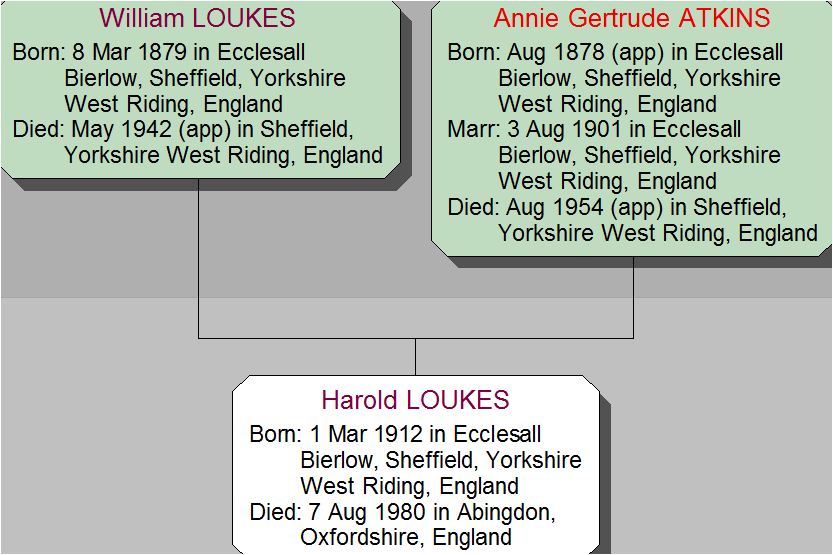
Harold Loukes is my fourth cousin, twice removed and below are his obituaries.

THE FRIEND – 12th SEPTEMBER 1980

Friends in Oxford, as elsewhere in the country, have suffered a great loss in the death of Harold Loukes, on August 7, at the age of 68. He had retired only a year ago and, though for most of that time he was aware that he had only a limited time to live, he continued his faithful service to the Society.

Harold Loukes was born and educated in Sheffield, and at JesusCollege, Oxford, where he took a First in English, followed by the Diploma in Education. Coming up to Oxford as a Methodist, he came in touch with Friends through Henry Gillet and became a member of the Society while still a student.

After Oxford, Harold went to St Stephen’s College, Delhi as a lecturer in English, and in 1937 he married Mary Linsell. He stayed in India until 1945, becoming Headmaster of the NewSchool at Calcutta and Darjeeling. Harold and Mary then returned to Britain with three sons. A daughter was born later- Harold gained experience at Oundle, LeightonPark and ThorneGrammar School before becoming lecturer (later Reader) in education at the Oxford Department of Education. There he taught for 30 years, entering fully into the ambitions and ideals of his students, and delighting many generations with his penetrating, experienced and witty lectures.

Throughout his many years in Oxford Harold was a loyal member of his meeting. He took a particular interest in Young Friends, and was for many years the ‘Senior Member’ (required by university regulations of the Oxford University Friends Society. Young Friends appreciated his combination of scholarship, spiritual depth, frankness and humility, and his keen sense of humour. The same qualities, together with his deep concern for the meeting, made him an outstanding elder. His ministry had a memorable beauty and calm, his spiritual insight was expressed in lovely and sometimes striking phrases. This was perhaps especially felt, when he spoke, as he often did, of the nature of Quaker worship, which he described as ‘ a living moment, a loving silence; the sound of the sea, the light behind the hills’. Meeting for worship, he told us in his last spoken message to Oxford Friends ‘is meant to be living, immediate, open to insight and interpretation. But there is a right ordering in the love of God, which we obey by quiet sensitivity and the holding in our tendered imagination of the needs of the other.’

Harold said that he found it a good discipline to think things out on paper. Throughout the postwar years that discipline has enriched the life of the Society of Friends and beyond with a series of books, study outlines, essays and articles. Apart from his extensive writings on the religious and other aspects of education, his books on

Quakerism, must have been instrumental in drawing many, especially younger readers, into the fellowship of the Society, and in deepening the beliefs of those born into it. He gave the 1959 Swarthmore Lecture, entitled The Castle and the Field, and the 1963 Rufus Jones Lecture in Philadelphia. He contributed countless reviews and articles to THE FRIEND, and was chairman of the Friends Home Service Committee from 1969 to 1973.

By careful planning Harold made full use of his life. Apart from his devotion to his family he had many public commitments. He was a JP for many years, and from 1975 to 1980 was chairman of Abingdon magistrates. He had been a governor of both maintained and independent schools and a member of Oxford Education Committee. He also had many friends and contacts in other churches.

Though he lived a very full life, Harold had time for friendship, and taking an interest in people. With all his experience he was a quiet, modest man. We loved him for the depth of his faith, but we loved also his jokes and the twinkle in his eye. We offer our deepest sympathy to his wife, Mary, and their family.

THE TIMES – 3RD SEPTEMBER 1980 – OBITUARIES – HAROLD LOUKES

Harold Loukes, who died on August 7, was educated at the Central Secondary School, Sheffield and at Jesus College, Oxford, where he gained a First Class in the Honours School of English Language and Literature. After graduating in 1934 he spent 10 years in India teaching in the University of Delhi and later serving as Headmaster of the New School, Darjeeling.

He returned to this country in 1945 and after four years as a schoolmaster he was appointed in 1949 to a lectureship in the Oxford University Department of Education and, in 1951, he became University Reader in Education.

During his 30 years in the Department he contrived to sustain three successful careers: his published works furnish adequate evidence of his capacity for competent empirical research and meticulous scholarship; he involved himself in civic affairs, as a school governor, a member of the Oxford City Education Committee and as a Justice of the Peace; but it is for his effectiveness as a teacher that he will be chiefly and gratefully remembered.
Michael Rodney Tyzack

Michael R. Tyzack

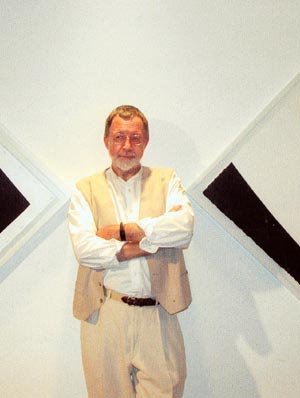
Michael Tyzack is my sixth cousin and below is his obituary.

THE INDEPENDENT – THURSDAY 19TH APRIL 2007 – OBITUARIES – MICHAEL TYZACK

Painter and jazz trumpeter who exchanged Sheffield and London for Charleston, South Carolina.

Michael Rodney Tyzack, painter and teacher: born Sheffield, Yorkshire 3 August 1933; married 1959 Patricia Burgin (one son, one daughter; marriage dissolved 1990), 1993 Anne Carson; died John’s Island, South Carolina 11 February 2007.

Michael Tyzack was one of the most distinguished British abstract painters to have settled in the United States in the last half-century. He went to teach and became a revered mentor for many young artists, telling them that ‘without risk, there is no serious painting’.

Initially Tyzack did not cross the Atlantic to settle, although he had for some time hankered to visit the country whose artists had made such an impact in Europe after the Second World War. When in 1971 he was invited to become visiting artist to the School of Art and Art History at the University of Iowa it was for just two semesters. This was gradually extended until he remained five years before moving to the School of the Arts, College of Charleston, in South Carolina, where he remained as Professor of Fine Arts.

Tyzack said that the transformative event in his career was winning first prize at the fifth John Moores Liverpool Exhibition in 1965, where the jury chairman was the influential American critic Clement Greenberg. Tyzack’s prize picture, Alesso B, was a seductively coloured acrylic on canvas. Although apparently completely abstract, it alluded in its title to the Renaissance painter Alesso Baldovinetti’s Portrait of a Lady in Yellow, in the National Gallery, a reproduction of which was pinned to Tyzack’s studio wall.

Robert Hughes and Norbert Lynton were among other critics to praise Tyzack’s work, Lynton supporting him in his first one-man show at the Axiom Gallery, London, in 1966. The Walker Art Gallery, Liverpool, acquired Alesso B. Asked how he would like viewers to respond to it, Tyzack answered simply: ‘I hope it gives them pleasure.’

Michael Tyzack was born in Sheffield in 1933, only child of Vincent Tyzack, a cutler, and his civil servant wife, Claire. They were proud and encouraging when Mike was enrolled at the Sheffield College of Art and Crafts, then achieved a place at the London University Slade School of Fine Art, gaining his fine art diploma in 1955.

On vacation in Sheffield and lacking a studio, Tyzack heard that the Sitwells’ family seat Renishaw Hall had abundant rooms and outbuildings. He asked for somewhere to paint, and a space was granted. A bonus, Tyzack’s first wife Patzy recalls, was the butler bringing a cup of tea on a tray. More daunting was a visit from the poetess Dame Edith, demanding: ‘Young man, what are you doing here?’

Tyzack had influential teachers at the Slade, among them the Slade Professor William Coldstream, Lucian Freud and William Townsend. In 1956, Tyzack won a French Government Scholarship in Fine Art and left for Paris, later spending time in Menton. Pictures painted in the south showed the influence of Cézanne and a tendency towards abstraction.

While at the Slade Tyzack had met British abstractionists such as Patrick Heron and William Scott and in the move from realism to abstraction he followed the course taken years before by another Slade teacher, Victor Pasmore.

When he returned to England after his stay in France, Tyzack spent several months working as a professional jazz trumpeter. Jazz had been a passion from his youth in Sheffield. He played in bands there and at the Slade, and after marriage in 1959 with his wife visited the London clubs to hear such admired bands as those of Ken Colyer and Humphrey Lyttelton. For two years Tyzack played with the Oriole Jazz Band, a Bristol group that recorded. ‘For Mike it was a serious business,’ says Patzy. ‘He would listen, whereas I thought we were going to dance and leap about.’

As a trumpeter Tyzack admired Louis Armstrong and Bix Beiderbecke, but his jazz interests were catholic. The music informed his painted work, as in the acrylic-on-cotton-duck picture Blue Monk (1982), finished as Tyzack heard of the pianist Thelonius Monk’s death. The sombre blue work reminds us that a psychological, emotional significance underlies its apparent abstraction.

Anyone who knows Tyzack’s mature geometrical abstracts could appreciate his respect for the work of such artists as Malevich and Mondrian. More surprising might be his reverence for those natural celebrators Matisse, especially, and Monet. Tyzack spent his 30th birthday seeking admission to Monet’s garden at Giverny, only to be turned away because it was closed for renovations. Patzy recalls: So he climbed over a wall and lay in the garden among the wistaria and rambling roses drinking his large bottle of champagne. The photographs he took are probably among the last before the renovations took place.

While teaching at such institutions as Cardiff and Hornsey colleges of art, Tyzack continued laying the foundations of a prolific exhibiting career, which would include over 50 British and overseas group show appearances. Among them were ‘Painting Towards Environment’ (Bear Lane Gallery, Oxford, with an Arts Council tour, 1964), ‘New Shapes of Colour’ (Stedlijk Museum, Amsterdam, with European tour, 1966) and the controversial ‘Documenta 4’ (Kassel, 1968). In addition, he had over 20 solo exhibitions.

His first solo show after moving to the US was at the Corcoran Gallery of Art in Washington in 1973 and in 1978 he was given a retrospective at the Frances Aronson Gallery in Atlanta, Georgia. The move to Iowa in 1971 affected the way that Tyzack saw the world, witness his acrylic-on-cotton-duck Nocturne (1972), in the collection of the Indianapolis Museum of Art. Although abstract, it is essentially lyrical and pastoral.

Having spent most of my creative life in dense, crowded urban environments, I seemed to experience the open expansiveness of the sky, as seen for the first time, in Iowa,’ said Tyzack. ‘This spatial expansiveness became incorporated in my paintings.’ He believed that the special quality of light in the Charleston area ‘informs my colour choice almost as much as my emotions’.

A serious car accident in the 1980s led to long and painful months, stretching into years of slow recovery. When he returned to his art, Tyzack exhibited a series of Small Nocturnes, drawings in mixed media on paper. In 1989 he went back to his diamond motif, which had begun with his painting Kremlin (1961). In 2001, it dominated his impressive solo exhibition at the Halsey Gallery, Simons Center for the Arts, in Charleston. ‘Appropriate to the Moment’, a title appropriated from the teachings of Zen Buddhism, comprised 18 works completed between 1989 and 2001. Tyzack’s colour variations were so subtle that sometimes they did not seem to be there. ‘Pessimists see an absence of colour, optimists the potential presence of colour,’ he said.

By now, Tyzack had work in three dozen international public collections, including the Tate Gallery, the Arts Council of Great Britain, the Victoria and Albert Museum, the Gallery of Ontario in Toronto, the Kunstmuseum in Berne, and the Arts Commission of South Carolina, Columbia.

Tyzack retired as head of the College of Charleston’s art department in 2005, when he became Emeritus Professor of Painting. He retained a studio on the campus and continued to teach, where his lust for life, generosity, quintessential Britishness, dry wit and aphorisms were appreciated. When a visiting former student expressed disappointment with graduate school compared with what had gone before, Tyzack wryly commented: ‘You thought it would be Nirvana, but it was bananas.’

Until a few weeks before his death, Tyzack continued to play jazz with his Dixieland band Authenticity. On trips to England he would jam with his guitarist son Ben, who has a recording group, the Spikedrivers.

Frank Decent Slingsby

Frank D. Slingsby

Frank Slingsby is my first cousin, twice removed. He died in October 1979 and below is his obituary.

THE MAN WHO DIDN’T WANT TO RETIRE

From a four shilling a week apprentice fitter to chairman of the family company that was the work record of Hull businessman Mr Frank D. Slingsby, who died yesterday at the age of 80.

He was chairman of G. and A. E. Slingsby Ltd. engineers, tube and valve specialists, of Cleveland Street, and had a work record stretching 59 years with the family firm.

Mr Slingsby took control of the firm in 1934 on the death of his father, and became chairman and joint managing director with his cousin when the business was incorporated in 1952.

During the post war years, he also built up a dairy herd of Jersey cattle, and was later joined by his two sons in the family enterprise of F. D. Slingsby and Sons based at Rowlston and Gransmoor.

Mr Slingsby, who lived at Willow Garth Rolston, never considered retiring, and attended his office until April this year.

He is survived by his two sons, Mr David Slingsby, present managing director of the engineering company, and Mr Jeffrey Slingsby, who runs the farming side of the enterprise.

Gertrude Ivy Mollekin

Ivy Mollekin

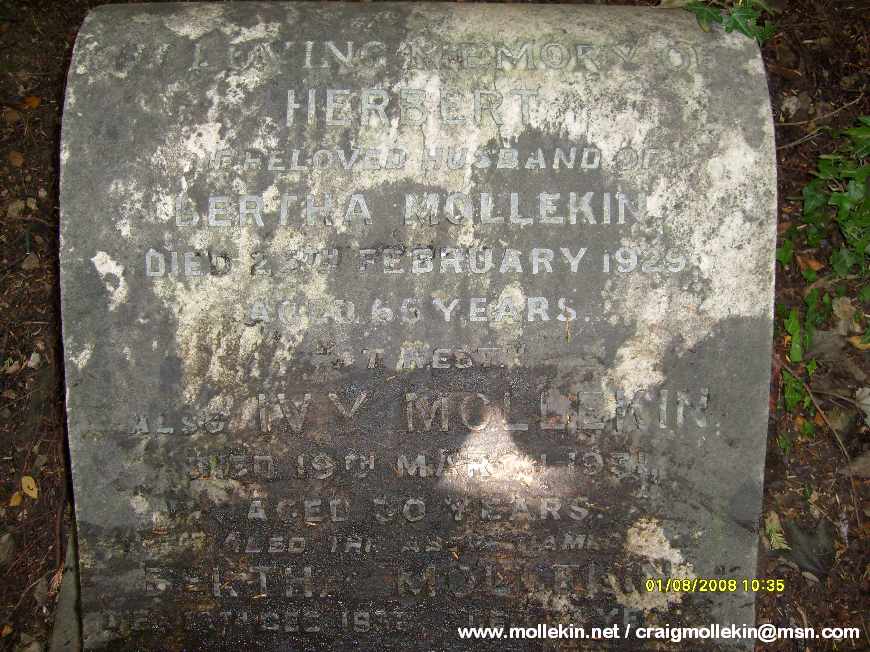
Gertrude Ivy Mollekin, born in Pontefract, is my first cousin, twice removed and daughter of Herbert Mollekin.

Below is a newspaper article published shortly after Ivy’s death.

ROTHERHAM ADVERTISER – SATURDAY 28th MARCH 1931 – DEATH OF MISS G.I. MOLLEKIN

The death occurred yesterday week of Miss Gertrude Ivy Mollekin, daughter of Mrs. and the late Mr. H. Mollekin, of ‘The Grange,’ Maltby. Miss Mollekin was only 30 years of age.

Prior to the interment, which took place in the Maltby Parish Churchyard on Monday, a service was conducted in the Parish Church by the Rev. H. R. Everson.

(Grave No. 30) Saint Bartholomew's Church, Maltby (8)

Ivy’s grave

The mourners were Mrs. Mollekin (mother), Mr. and Mrs. G. H. Mollekin (brother and sister-in-law), Mr. and Mrs. E. Mollekin (brother ad sister-in-law), Mrs. Brookes (sister), Mr. and Mrs. McGlade (brother-in-law and sister), Mr. and Mrs. S. Mollekin (brother and sister-in-law), Mr. and Mrs. H. L. Mollekin (brother and sister-in-law), Mr. and Mrs. Stan Mollekin (brother and sister-in-law), Mr. and Mrs. J. Sadler (brother-in- law and sister), Messrs. Claud, Fred, and Jack Mollekin (brothers), Mr. Skinner and daughter (uncle and cousin), Mrs. Pearson (aunt), Mr. and Mrs. J. Mollekin (uncle and aunt), Mr. Morgan R. Jones, Mr. A. J. Booth, Mr. E. Davy and Mr. A. Plant (Sheffield), Messrs. T. Ridgway, M. Wilden, H. Box and E. Shaw acted as bearers. Wreaths and floral tributes were sent by ‘Mother,’ ‘Fred, Claud and Jack,’ ‘Sybil and Jack,’ ‘Mabel and Ernest,’ ‘Harry, Dolly, Basil and Beryle,’ ‘Sid and Lill,’ ‘Dorothy, Ernest and family,’ ‘Uncle Walter and cousins,’ ‘Bert, Daisy, and Herbert,’ ‘Lizzie and Walter,’ ‘Aunt Alice,’ ‘Winnie and Stanley,’ Mr. and Mrs. J. Mollekin, Mr. and Mrs. Fletcher and family, Mr. and Mrs. A. J. Booth, Ald. And Mrs. Dunn, Mr. and Mrs. M. R. Jones, Mr. and Mrs. K. Davy, and Mr. and Mrs. F. Hunter.

Bertha Kennington

Bertha Kennington

Bertha Kennington, born in Hull, is the wife of my great grand uncle, Herbert Mollekin.

Below is a newspaper article published shortly after Bertha’s death.

ROTHERHAM ADVERTISER – SATURDAY 24th DECEMBER 1938 – THE LATE MRS. BERTHA MOLLEKIN

The funeral took place in the Maltby Parish Churchyard on Tuesday of Mrs. Bertha Mollekin, of Blyth Road, Maltby, who died last Friday. The deceased lady, who was 78 years of age, collapsed at her home. A native of Hull, Mrs. Mollekin had resided in Maltby for 34 years. Her late husband was in business there as a master builder up to his death nine years ago. He will also be remembered as a northern racehorse owner. Mrs. Mollekin did not take an active part in local affairs, but she always supported any deserving cause. She had 16 children, and leaves eight sons and four daughters, with 27 grandchildren and one great grand-child. Prior to the interment a service was conducted in the Parish Church, Maltby, by the Rev. W. A. Burtees, who also officiated at the graveside. The mourners included Mr. and Mrs. G. H. Mollekin, Mr. and Mrs. Ernest Mollekin, Mr. and Mrs. Sidney Mollekin, Mr. and Mrs. Stanley Mollekin and Mr. and Mrs. Jack Mollekin (sons and daughter-in-law), Mr. Fred Mollekin and Mr. Claud Mollekin (sons), Mr. and Mrs. E. J. McGlade, Mr. and Mrs. H. Nicholson, Mr. and Mrs. J. Sadler and Mr. and Mrs. H. Brooks (sons-in-law and daughters), Mrs. Pearson (sister), Mr. and Mrs. J. Mollekin (brother-in-law and sister-in-law), Mr. Frank Hunter (who had worked with Messrs. Mollekins for about 50 years), Mrs. E. Davy, Mrs. Harris and Mrs. E. Dunn. Messrs. Barker C. White, Stables, E. Davy and T. Ridgeway represented the workmen of Mollekin Bros., and Messrs. Firth and W. Godber the firm. Messrs. Morgan R. Jones (Surveyor) and Mr. R. Oddy (Sanitary Inspector) represented the Maltby Urban District Council. Others present were Mr. Charles Stevens, Mr.

Bertha’s Grave

George Brown, Mr. Sadler of Sandbeck, Mr. and Mrs. Barlow, Mrs. T. Holdsworth, Mr. A. J. Booth, Miss Franks and Mrs. Davies. Floral tributes were sent by ‘Dolly, Harry and children,’ ‘Fred and Claude,’ ‘Harry, Ada, Polly and Derrick,’ ‘Mabel and Ern,’ ‘Jack and May,’ ‘Stan and Winnie,’ ‘Jack and Gilbert,’ ‘Sybil, Jack and Betty,’ ‘Ernest, Dorothy and grandchildren,’ ‘Bertie, Daisy and Herbert,’ ‘Sid, Lil and children,’ ‘Alice Pearson,’ Mr. and Mrs. E. Dunn, ‘Hatty,’ ‘Lauri Steeples,’ George Smith, chairman and members of the Maltby Urban District Council, Mrs. Harris, Mr. and Mrs. Whitley and family, Mr. and Mrs. F. Hunter, Maltby workmen of Mollekin Bros., Cannock workmen of Mollekin Bros., E. Butler and Sons, ‘Aunt Annie and Uncle Jack,’ Mr. and Mrs. T. White, ‘Thomas and Charles,’ Mr. and Mrs. E. Davy, ‘W. Godber,’ Mr. and Mrs. F. Pearson and family, Mr. and Mrs. J. T. Downing and family, Mr. and Mrs. J. T. Downing, of Sheffield, Mr. and Mrs. J. C. Stevens, Halliday and family, Mrs. Bootman, Mr. and Mrs. T. Houldsworth etc. The relatives of the late Mrs. B. Mollekin wish to thank the doctor for his kindness to Mrs. Mollekin during her illness, also those who sent kind messages of sympathy and floral tributes during their great bereavement.

Rowbottom – Mollekin Marriage

Mollekin - Rowbottom Marriage Collage

Mollekin – Rowbottom Marriage

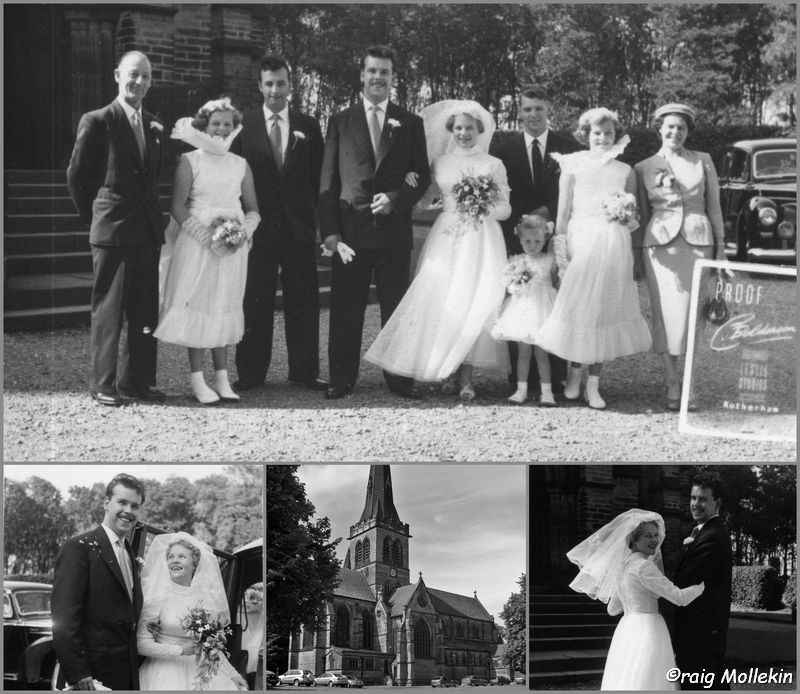
My parents were married in September 1957. Below is a newspaper article which describes this occasion:-

The marriage took place at Wentworth Church last Saturday of Miss Jean Rowbottom, eldest daughter of Mr. and Mrs. H. Rowbottom, 3. Street Cottages, Wentworth, and Mr. James Barrie Mollekin, youngest son of Mr. J. G. Mollekin, 109. Melciss Road, Wickersley, and the late Mrs. Mollekin. The Rev. R. B. H. Greaves, of Elsecar, officiated, and the organist was Miss E. Tradewell.

The bride, given away by her father wore a gown of white lace over nylon and a short veil and pearl coronet head-dress, and carried a bouquet of pink roses, lilies-of-the-valley and fern.

George & Dragon, Wentworth

George & Dragon

The bridesmaids were Misses Denise and Ann Rowbottom (bride’s sisters) wearing white ballerina-length nylon dresses, pink Juliet caps and elbow length nylon gloves; and Miss Susan Mollekin, wearing a white net over pink silk dress with white accessories. All three carried posies of pink carnations, sweet peas and fern.

The best man was Mr. John Mollekin and the groomsman Mr. Tom Kelsall.

The bride’s mother received 57 guests at the George and Dragon Hotel in a pink two-piece, grey hat and gloves and wearing a spray of pink carnations.

The honeymoon was spent at Paignton, Devon, the bride travelling in a royal blue costume with accessories to tone.

Pinder – Mollekin Marriage

Pinder – Mollekin Marriage

My paternal grandparents married in 1925 and were called Edith Mary Pinder and John Gilbert Mollekin. Below is a newspaper article which describes this occasion.

WEDDING AT EASTWOOD – PINDER – MOLLEKIN

A wedding which took place at the Eastwood Wesleyan Chapel on Monday week, aroused an unusual amount of local interest, owing to the close association of the bride with the Eastwood Chapel. The contracting parties were Miss Edith Mary Pinder, eldest daughter of the late Mr. M. H. and Mrs. A. Pinder, of Bethel road, Rotherham, and Mr. John Gilbert Mollekin, son of Mr. and Mrs. John Mollekin, of Maltby. The officiating minister was the Rev. H. Bemrose Spencer.

Bethel Road, Eastwood, Rotherham - 06.07.17 (1)

Bethel Road, Eastwood, Rotherham

Many relatives and friends from Sheffield, Scarbro’, Blackpool, Woodhouse, Maltby, and other places were present.

The bride was charmingly attired in a pretty blue costume, with hat to match. Miss Marjory Pinder gracefully performed her duties as bridesmaid to her sister, and was similarly costumed in style and colour. Mr. J. F. Pinder (brother of the bride), of Eastdene, gave the bride away, and Mr. Alfred Ernest Hunter, of Sheffield (cousin), carried out the duties of best man. Mr. Francis Pinder (grandfather of the bride), presided at the organ. The hymns, “Lead us Heavenly Father” and “O Perfect Love” were sung, and as the bridal pair were leaving the church the organist played Mendelssohn’s “Wedding March.”

The guests afterwards adjourned to the home of Mr. J. F. Pinder, Eastdene, where the repast was served.

Pinder – Mollekin Marriage

Later in the day, the bride and bridegroom journeyed on to Scarbro’ to spend their honeymoon at the home of the bride’s aunt, Mrs. Dickinson, of “Rotherwood House,” North Side.

The bride was the recipient of many beautiful presents, the outstanding gift being one from Mr. Hirst, her late employer, of the firm of Messrs. Hirst and Son, tobacco manufacturers, Leeds and Scarbro’. The bride held a very important position at the Scarbro’ branch of their business in Bar street, and was held in high esteem by the head of the firm and employees. The gift from Mr. Hirst consists of a pretty cut glass salad bowl, mounted with a sterling silver hand round the top, accompanied with two silver spoons.

This post was originally published on Mollekin Portalite on 12/10/2011.

David Nicholson – The Duke

David Nicholson

David Nicholson is my third cousin and the grandson of Herbert Mollekin. David was a renowned horse trainer and the newspaper article below gives an insight into his life and achievements.

THE DAILY TELEGRAPH – TUESDAY 29TH AUGUST 2006 – OBITUARIES – NATIONAL HUNT TRAINER WHO SENT OUT SOME 1,500 WINNERS AND NURTURED SOME OF OUR FINEST JOCKEYS

DAVID NICHOLSON, who died on Sunday aged 67, was one of the most successful National Hunt trainers of his era.

Known to all as ‘the Duke’, Nicholson sent out 1,499 winners during his 31 years as a trainer; earlier in his career he had enjoyed success as a jump jockey.

There was never much doubt that David Nicholson would make his life in horse racing. Born at Epsom on March 19 1939, he was the son of Frenchie Nicholson and his wife Diana.

Frenchie had been a joint champion jump jockey before becoming a successful trainer based in Cheltenham; his training establishment was known as the ‘Frenchie Nicholson Academy for Riders’ in tribute to the number of successful jockeys produced there; they included Pat Eddery, Walter Swinburne and Tony Murray. Diana Nicholson was the daughter of the Cheltenham trainer William Holman.

David was educated at Haileybury, but from the age of 12 he rode as an apprentice to his father. He remained in that role until 1960, and was a professional jump jockey until 1974. He once said that he had deliberately volunteered to ride bad horses because he enjoyed ‘getting the buggers round’.

Nicholson rode 583 winners as a jump jockey; and although he never finished higher than third in the jockeys’ table, he had some fine wins to his credit. He won the Whitbread Gold in 1967 on Mill House; the Imperial Cup in 1960 on Farmer’s Boy; the Cathcart Chase (1962, on Hoodwinked); the Schweppes Gold Trophy (1965, on Elan); and the Champion Chase in 1971 on Tantalum. His last winner was aboard What A Buck, on April 3 1974 at Hereford. In 1961 he had bought Cotswold House, at Condicote, in Gloucestershire, and in 1968 he had taken out a license to train. His first winner as a trainer came with Artic Coral, at Warwick on January 9 1969, but his new career was slow to take off. It was not until the early 1980’s, when there was an influx of faster, Flat-bred horses, and when he had the riding services of Peter Scudamore, that he really began to make his mark.

Nicholson’s greatest moment as a trainer was undoubtedly winning the Gold Cup with Charter Party in 1988; but he won many other high class races at Cheltenham Festival. These included the Triumph Hurdle (in 1986 with Solar Cloud, and in 1994 with Mysilv); the Arkle Challenge Trophy (1989, Waterloo Boy); the Queen Mother Champion Chase (1994 and 1995, with Viking Flagship); and the Stayers’ Hurdle (1999, Anzum).

He had other big-race successes too, among them the Sean Graham Hurdle with Broadsword in 1981; the Mackeson Gold Cup, in 1986 with Very Promising, and in 1991 with Another Coral; and the king George VI Chase in 1993 with Barton Bank. He also won two Scottish Grand Nationals (Moorcroft Boy in 1996, and Baronet two years later).

Nicholson’s career was not without its setbacks, however. By the late 1980s his training operation was experiencing financial difficulties, and he was fortunate to be invited to move, in October 1992, to the purpose-built, 80-box Jackdaws Castle, in Gloucestershire, developed by a retired construction engineer, Colin Smith. Smith installed Nicholson as a salaried trainer with a renewable five-year contract; he also looked after the business side, leaving Nicholson to give all his attention to the horses.

This arrangement proved a great success. In his first season at Jackdaws Castle Nicholson sent out 100 winners, at that time only the fifth jumps trainer since the war to do so.

Nicholson was champion National Hunt trainer in 1993-94 and 1994-95. His innate gifts as a trainer were augmented by a talented procession of stable jockeys. Among them Peter Scudamore (1980-86), Richard Dunwoody (1986-93), Adrian Maguire (1993-99) and Richard Johnson (1999).

Nicholson prized loyalty and good sportsmanship. A traditionalist who retained great respect for the old steeplechasing days, he was a stickler for correct dress. He held strong views and was never reluctant to speak his mind; when wishing to make a point forcibly, he would jab his finger into his interlocutor’s chest. One of his admirers, the racing commentator Alastair Down, once conceded: ‘He was never going to be a loss to the public relations industry.’

In 1995 he was fined £1,500 by the Jockey Club Disciplinary Committee following a confrontation with a photographer at Kempton Park; after the hearing Nicholson remarked: ‘It’s a stiff fine, but nothing a large brandy wouldn’t cure.’

Asked 10 years ago how he would like to be remembered, Nicholson replied: ‘A good tutor of jockeys, a good schooler of horses and a hard bastard.’ He was a convivial man who enjoyed celebrating his wins with a ‘serious glass’. At a jockeys’ ball in 1970 he threw a raw egg, inadvertently hitting Mrs Frank Osgood, wife of the clerk of the course at Newbury, on the side of the face. He apologised in a telephone call and sent her a bunch of flowers.

A great cricket enthusiast, he was a member of MCC.

Nicholson published an autobiography, The Duke, in 1995, and retired from training in 1999. In March 2002 he was appointed the British Horseracing Board’s bloodstock representative, responsible for promoting British-bred horses at home and abroad.

David Nicholson married, in 1962, Dinah Caroline Pugh, whom he usually referred to as ‘mother’; they had two sons.

RACING – NATIONAL HUNT LEGEND ‘THE DUKE’ DIES AT 67

DAVID NICHOLSON, leading jockey and championship trainer, man of the Old School and racing ambassador, who has died, aged 67, was truly a National Hunt legend, one of whose involvement in the sport spanned a lifetime.

Nicholson was universally known as ‘The Duke’. His trademarks were red socks, sheepskin coat, and the stubborn approach of one moulded by the strict regime of a famous father and a desire to succeed in a tough game about which he was passionate.

The stab of the right index finger into the chest of a listener most definitely made Nicholson’s point in conversation, but he also left his mark in countless other ways. Partnering 583 winners over 20 years as a jockey, two trainers’ titles, success in the Cheltenham Gold Cup, two Queen Mother Champion Chases, and being part of the famous Jackdaws Castle training complex from scratch, were well-known achievements.

Also, the influence on young men who were to make their names as jockeys, including Peter Scudamore, Richard Dunwoody, Adrian Maguire and Richard Johnson, as well as Alan King, a rising star in the trainers’ ranks. And then there was his tutoring of the Princess Royal on the finer points of riding under Rules. He was also particularly proud that he had given around 100 jockeys their first race rides.

But the story that is not quite as well known was Nicholson’s lifelong fight for survival after first displaying the symptoms of asthma when only six months old. Allergies (including one to horses) afflicted him in childhood to the extent that milk, eggs, fish, jelly and fat were cut out of his diet, and his mother kept a nightly vigil as he was continuously wheezing as he slept.

A series of terrifying asthma attacks in childhood left him close to collapse, yet he was determined to be a jockey and pestered his father, the trainer (and ex-jockey) Frenchie Nicholson, so much that his first race ride came in the Brandon Apprentice Plate at Newmarket in 1951 when he was barely 12 years old.

Those, who knew The Duke only in his latter years would be surprised to learn that he tipped the scales that day at a mere 4st 7lb and needed to carry another 4st in dead weight to reach the required 8st 9lb of his mount Fairval. ‘My hands were in such a muddle, I nearly poked my eye out trying to hit the poor horse – and I was too weak to carry back the saddle,’ he was to recall.

His only winner on the Flat came at an evening meeting at Wolverhampton when, riding a horse called Desertcar, he beat Lester Piggott into second. He described it as ‘a pretty humdrum race.’ Soon after, he was to concentrate entirely on jumping.

King, who was The Duke’s assistant for many years before taking out his own licence, said: ‘He had such a love for the support and he leaves behind so many legacies.’

Trainer Nicky Henderson said: ‘He was a larger-than-life man who gave everything to racing. He became a great friend and everyone respected him.’

Dunwoody, who partnered Charter Party to Nicholson’s most famous win as a trainer, in the 1988 Gold Cup, said: ‘He was a fantastic boss.’

Nicholson retired from training in 1999 and soon enthusiastically embraced a new position specially created for him by the Thoroughbred Breeders’ Association, that of roving ambassador.

He was a Deauville for the important sales weekend only nine days ago. Braving the elements – it had been lashing rain most of the weekend – The Duke appeared in the winner’s enclosure after the running of the Group One Prix Morny, won by Paul and Susan Roy’s Dutch Art. Beckoning me closer, the finger wagged in proclamation: ‘Don’t forget, the winner is British-bred.’

This post was originally published on Mollekin Portalite on 12/10/2011.

Halliday Crompton

Halliday Crompton

Halliday Crompton, born in 1889 in Bury, is the husband of my first cousin, twice removed, Bertha Lily Mollekin.

It is interesting to note that Halliday is a distant relation of the authoress, Richmal Crompton, who authored the ‘Just William’ books.

BURY TIMES – 10th JANUARY 1948 – MR. HALLIDAY CROMPTON

The death took place suddenly in Bury Infirmary on Thursday of Mr. Halliday Crompton, of 102, Walmersley-road. He was 58 years of age.

Mr. Crompton, who was the second son of the late Mr. W. W. Crompton, a Bury solicitor, and brother of the late Mr. Alfred and Mr. Neville Crompton, also well-known solicitors in the town, was educated at Giggleswick School. He took to farming as a career, living at Waddington, near Clitheroe, until his wife died, 20 years ago, when he returned to Bury.

One of the last events he was able to attend was the marriage of his youngest daughter at St. Peter’s Church, Bury, three weeks ago.

Mr. Crompton was a member of the Trevelyan Club for a long number of years and was also associated for many years with the Central Conservative Club.

At one time he was a representative of Mr. William Crompton, chemist, of Bolton-street, and before his retirement was assistant to Mr. Frank Butterworth, auctioneer and estate agent, of Bury.

He leaves two sons and four daughters.

The funeral will be at Waddington Parish Church at noon on Tuesday.

This post was originally published on Mollekin Portalite on 10/10/2011.

Bungling Police

Terry Loukes

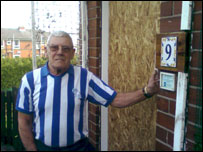
The newspaper article below always amuses me. This incident concerns my third cousin, once removed who is called, Terry Loukes.

SHEFFIELD STAR – 27TH MARCH 2007 – BUNGLING POLICE RAID OAP’S HOUSE

BUNGLING police smashed down a disabled Sheffield pensioner’s door during a drugs raid… at the wrong house.

Widower Terry Loukes, aged 72, who suffers from spinal arthritis, was taking an afternoon nap when he realised someone was approaching his front door.

He got up to answer it but, just seconds later, the door came crashing in – missing him by inches.

Terry, a retired car showroom worker, of Haslehurst Road, Wybourn, says four policemen – all wearing full body armour and crash helmets – then pushed past him to search his house.

Terry said: ‘I was lying on my settee when I heard my intruder alarm go off. I have one in the garden because my shed was broken into recently. As soon as the alarm sounded I got up and noticed someone standing at the door.

‘I shouted, ‘Just a minute’, and told the person I was about to open the door. But he shouted, ‘Get back’, and it came crashing in.

‘Next thing there were four policemen in my house, up my stairs, in my front room and in my kitchen. There were more policemen standing in the garden.

‘The officer asked me if I lived here and I said, ‘Yes, for 35 years’.’

Officers told Terry they had a warrant to search the address but quickly realised they were in the wrong house.

‘I’ve never known anything like it,’ said Terry. ‘I mean, this doesn’t look like a drug dealer’s house – how many drug dealers have gnomes in their garden?’

Terry, who was in a state of shock, said he was comforted by an officer who made him a cup of coffee.

He added: ‘He couldn’t apologise enough and told me he’d come back next week with a bottle of whisky for me, but I don’t even drink.’

Terry who even has a South Yorkshire Police ‘No Cold Callers’ sign by his front door, is now finding it difficult to sleep and plans to see his GP. ‘I’m a bag of nerves,’ he said.

Inspector Andy Male, who heads up South Yorkshire Police’s Safer Neighbourhood team, personally called to see Terry within minutes of learning of the mistake.

He apologised, ensured the door was boarded up, and promised to have it replaced.

‘The warrant was executed at the wrong address,’ Insp Male confirmed today.

‘The mistake came about due to intelligence being incorrectly attributed.

‘Occasionally this happens and we are reviewing the process.

‘We are very sorry about the damage done to Mr Loukes’ door.’

This post was originally published on Mollekin Portalite on 10/10/2011.