Coronation Festivities In Maltby

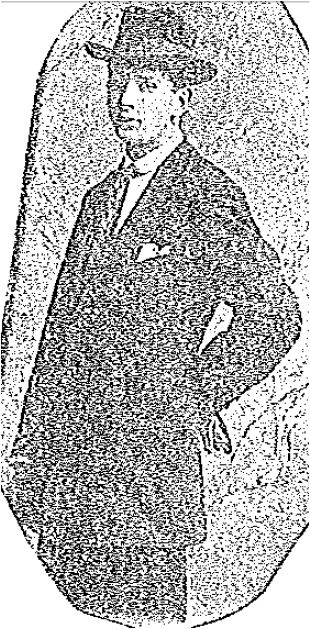
melton-vasey-herbert-mollekin-jockey

Herbert Mollekin (centre)

Below are a couple of newspaper articles regarding 1911 Coronation festivities arranged by Herbert Mollekin in Maltby, South Yorkshire. My grandfather, John Gilbert Mollekin, could remember this occasion. John would only have been aged thirteen but remembered everybody being dressed in dinner suits and there being plenty of champagne flowing.

ROTHERHAM ADVERTISER – SATURDAY 17TH JUNE 1911 – MALTBY

CORONATION FESTIVITIES, – Messrs. Mollekin and Co. builders and contractors, are going to entertain about 350 of their workmen, wives and sweethearts at Maltby. Sports, dancing, etc., will take place, and at five o’clock tea will be provided. A large marquee is to be erected to hold 500, and a special floor to be put in for dancing in the evening. There will also be a fireworks display. All the workmen from Moorthorpe, Grimethorpe, Frickley, Hemsworth and Maltby will be invited. A special train from South Elmsall will be run if found necessary.

Herbert Mollekin with chauffeur

THE ROTHERHAM ADVERTISER – SATURDAY 24TH JUNE 1911 – ANNUAL TREAT OF EMPLOYEES AT MALTBY

To celebrate the Coronation of the King 250 of the employees of Messrs. Mollekin, of Maltby, were entertained in truly handsome fashion on Thursday by Mr. Mollekin. The large field behind his residence afforded ample scope for sports. A large marquee was erected to accommodate the guests to a sumptuous dinner, and served for dancing to the strains of Messrs. Graley’s celebrated string band from the city of Leeds. Mr. Mollekin proposed the loyal toast, which was enthusiastically received by the company. The toast of their worthy host, proposed in felicitous terms by Mr. Norman Gibbs, and seconded by Mr. J. Woolhouse, was feelingly responded to by Mr. Mollekin, who thanked them all most heartily for their good wishes so happily expressed by his friends who were responsible for the toast.

Coronation lamp in Conisbrough

A pleasant interlude in the proceedings was the presentation to Mrs. Mollekin of a pretty and valuable gold pendant, and a silver cigarette case to Mr. Mollekin by Mr. C. Farrar on behalf of the employees. Mr. Farrar referred to the excellent spirit pervading the gathering, and said he was pleased to have an opportunity of meeting them under such auspicious circumstances, and on their behalf presenting to Mr. and Mrs. Mollekin those tokens of their esteem and regard. The gifts were duly acknowledged by the recipients. Prizes to the winners of the various events were distributed, and everything was done on a most lavish scale for, the enjoyment of the numerous guests, one of whom (Mons. P. N. Horeau) had travelled from Bordeaux in order to be present. Harmony prevailed throughout, and the cordial relations between the firm of Messrs. Mollekin and those who work for them was pleasingly evident in all that was said and done during the day.

Jack Sails To America

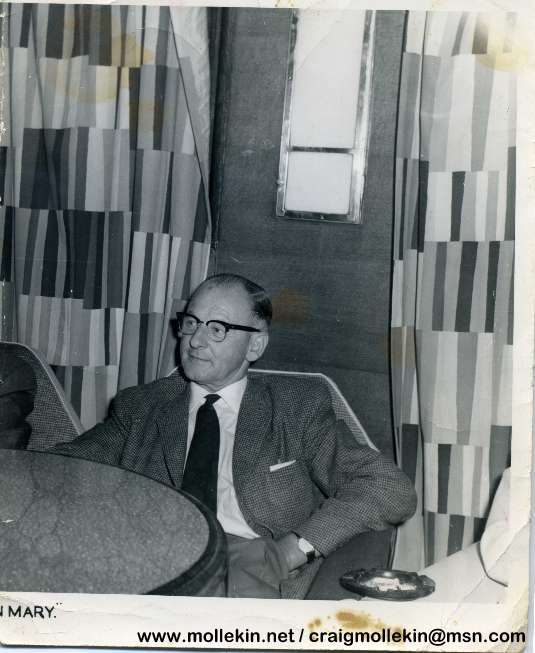
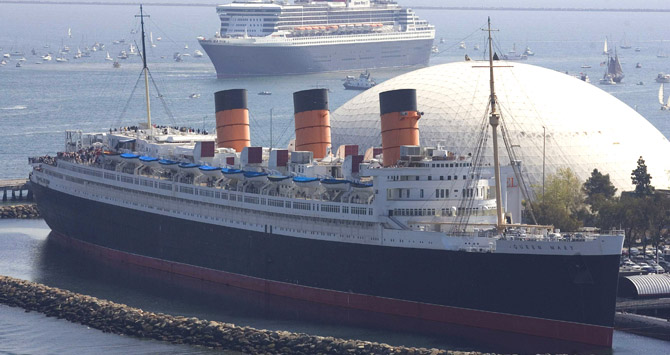
Jack aboard the Queen Mary

My grandfather, John (Jack) Gilbert Mollekin, wished to meet his granddaughter, Linda K. Kennedy, before he died.  Linda’s mother, Beryl, died just fours days after Linda was born.  John worked for an additional two years which enabled him to make two or three visits to America, each visit lasting for a number of months.  John even got married on one of these visits.  Below is a combination of three newspaper articles which describe the occasion of John meeting his granddaughter for the first time.

JOHNSON CITY, TENNESSEE, PRESS-CHRONICLE -WEDNESDAY MORNING, 26TH JUNE 1963

Jack Mollekin, 65, a retired railways employee from Yorkshire, England, arrived in New York Tuesday aboard the Queen Mary to begin the land leg of his journey to Tennessee. Mollekin is making the trip the trip to see his granddaughter, Linda K. Kennedy, 17, for the first time. Linda’s mother moved to Tennessee but died at childbirth and Mollekin resolved to see his granddaughter before he died. Linda now lives in Hampton, Tennessee.

HAMPTON LASS AWAITS VISIT FROM ENGLISH GRANDFATHER

NEW YORK (AP) – An Englishman arrived yesterday on the liner Queen Mary en route to Hampton, Tennessee, to see his 17-year old granddaughter for the first time.

He is Jack Mollekin, 65, a retired British Railways employee, of Yorkshire, England.

His daughter is Linda K. Kennedy, a student at Hampton High School.

Her mother-Mollekin’s daughter-died in childbirth in Johnson City, Tennessee. Her name was Beryl Marjory Mollekin. She was married to a member of the U.S. Air Force, Andrew (Jack) Kennedy in England in 1945.

Queen Mary

REMARRIED

She joined him at his East Tennessee home, after his return from overseas. Kennedy has since remarried.

Mollekin’s wife died 11 years ago without seeing her granddaughter. The grandfather resolved to see her before he died and saved his money until he could afford the trip.

‘I have seen hundreds of photos of my granddaughter,’ said Mollekin, a trim, smiling Englishman in an interview aboard the Queen Mary. ‘I have seen her grow up from a baby in pictures.’

He planned to board a (Trailways) bus at 9.30 p.m. EDT

ENGLISHMAN MEETS GRANDDAUGHTER FOR FIRST TIME

Eyes were suspiciously bright as a handsome, well – groomed grandfather arrived yesterday to see his granddaughter after travelling more than 3,000 miles by sea and land to realise a long-cherished dream.

The grandfather is Jack Mollekin, 65, from Yorkshire, England, who began his trip to Hampton, Tennessee on June 19. He arrived in New York City on the liner Queen Mary on June 25, took the first bus out, arriving at the local Bus Terminal at 12:40 p.m. yesterday.

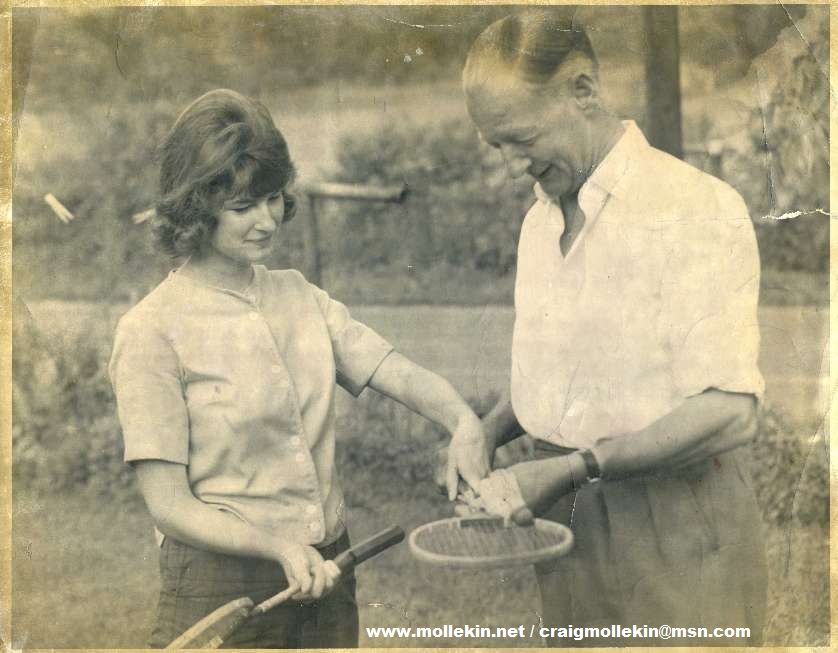
Linda K. and Jack

And awaiting him in a state of extreme excitement was the lovely granddaughter, Linda Kay Kennedy, with who he has kept in close touch all through her 17 years.

A war time romance ended when Linda’s mother died in childbirth. She had joined her husband Andre “Jack” Kennedy here after his discharge from the Armed Forces, and in giving birth to the baby, Mrs. Beryl Marjory Mollekin Kennedy died in a Johnson City Hospital.

Mollekin, a retired British Railways employee, resolved many years ago to make the trip to America to visit his granddaughter. His wife died 11 years ago before the two of them had an opportunity to come to this country, but the grandfather’s resolve held firm.

“Seeing him is wonderful,” said Linda, whose beaming smile and happy expression told their own story. Mollekin said, “She looks like her mother.” and there is a striking resemblance to the grandfather.

The trim, well-dressed Englishman said that he had met many Americans on the Queen Mary and was impressed with their friendliness. He though the scenery between here and New York Cirt quite beautiful, but from Bristol on his excitement mounted until he could hardly await his arrival in Elizabethton.

Newspaper personnel and photographers from the entire area were on hand to witness the first meeting of a grandfather she had long to see. They were not disappointed since it was a human interest story of the ecstatic happiness of two persons, separated for all of Linda’s years by the Atlantic Ocean.

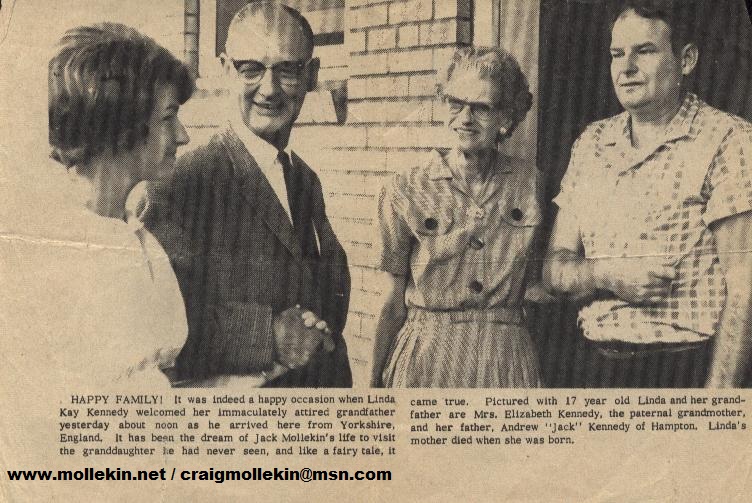
Linda’s father was a member of the U.S. Air Force when he met and married Marjory Mollekin, and he was on hand to welcome Mr. Mollekin. Kennedy has since remarried. And also present for the memorable occasion was Linda’s paternal grandmother, Mrs. Elizabeth Kennedy, who appeared quite happy to see that5 the dream of her granddaughter and the maternal grandfather had at last come true.

The two principals in the meeting recognized each other instantly, and Linda was enfolded in the arms of the grandfather she had longed to see. It was definitely a beaming grandfather who held her off to get a good look at Linda in person.

Mollekin expects to remain in this country until the latter part of August. He will no doubt take back to England with him a fond recollection of the warm welcome and hospitality accorded him here.

In an interview aboard the Queen Mary, the visitor told reporters that he had seen hundreds of photos f his granddaughter and said, “I have seen her grow from a baby in pictures.”

Meeting

KISSES AND SMILES MARK MEETING OF LINDA, GRANDDAD

ELIZABETHTON – “It’s just wonderful, seeing him at last,” said 17-year-old Linda Kennedy, of Hampton, as she planted a kiss on the cheek of her grandfather, newly arrived here from England.

Jack Mollekin stepped from a Trailways bus at 12:40 p.m. here, where smiling and happy, he fulfilled his dream to see his granddaughter before he died.

The 65-year-old retired British railways employee from Yorkshire, England, travelled for one week over land and sea to meet his kin.

Linda said she and her grandfather have been corresponding through the years, and he has seen hundreds of pictures of here.

She has been looking forward to his arrival for the past month, after he wrote her he was coming. Linda’s father, Andrew B. Kennedy Jr., said that before Mollekin’s arrival yesterday, “She’s very excited.”

But grandfather Mollekin was also anxiously awaiting the great moment, as he said, “I’ve been excited ever since I left.”

Asked what his plans are and if he intended to stay awhile in Tennessee, he replied, “Well, I don’t know yet….my visa isn’t up until the end of August.”

Linda resides in Hampton with her grandmother, Mrs. Elizabeth Kennedy. Her mother, Mollekin’s daughter, died in childbirth in Elizabethton. She was Beryl Marjory Mollekin, who married Andrew Kennedy in 1945 when he was serving with the U.S. Air Force. Kennedy has since remarried.

The immaculately – groomed Englishman said he has been saving money to afford the trip. When his wife died 11 years ago, without ever seeing her granddaughter, Mollekin resolved he would see her.

He left Yorkshire on the liner Queen Mary and arrived in New York Tuesday.

Mollekin met lots of American aboard the liner, and said his trip was wonderful…..but the happiest moment of all was meeting Linda.

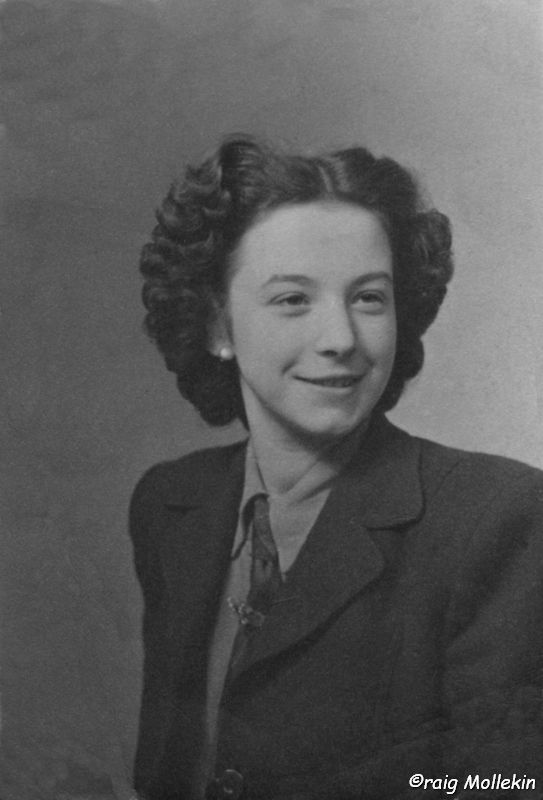
Beryl Marjory Mollekin

BMM (4)

Beryl M. Mollekin

My aunt, Beryl Marjory Mollekin, the daughter of Edith Mary Pinder and John Gilbert Molleken was born in 1926, in her grandmother’s home on Bethel Road, Eastwood, Rotherham.

Beryl lived the first few years of her life at 33 Bentley Road, Bramley, Rotherham, before moving to a newly erected house on Melciss Road in Listerdale, Wickersley.

As a teenager, Beryl began working as a Clerk at the Masbrough Goods Railway Station in Rotherham. Before joining the Army, my father also worked here.

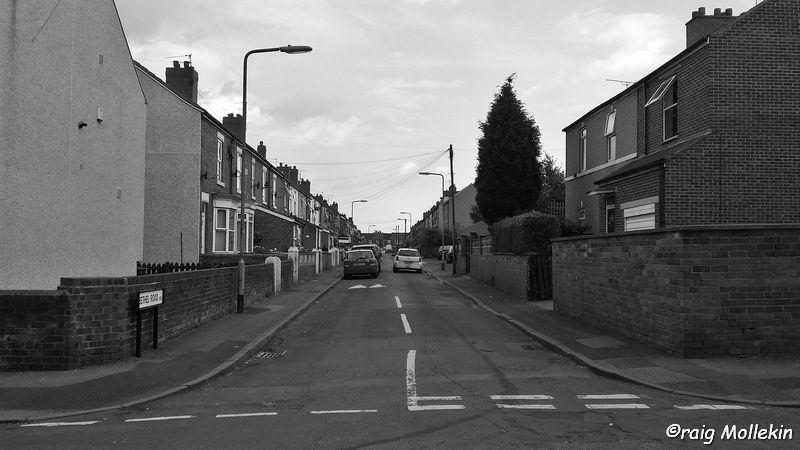
Bethel Road, Eastwood, Rotherham - 06.07.17 (1)

Bethel Road, Eastwood, Rotherham

My father remembered Beryl having a Polish boyfriend who was a pilot in the Royal Air Force. I can’t remember this gentleman’s name, but I seem to recall my father saying that he gave him sweets etc. and was good-natured and friendly towards him. My father remembered how one evening, his sister was in a hysterical state, with her parents trying to calm her down without success. My father surmised, years later, that this was when her Polish boyfriend had been killed in action.

saint-albans-church-wickersley-23-11-13-24

Saint Alban’s Church, Wickersley

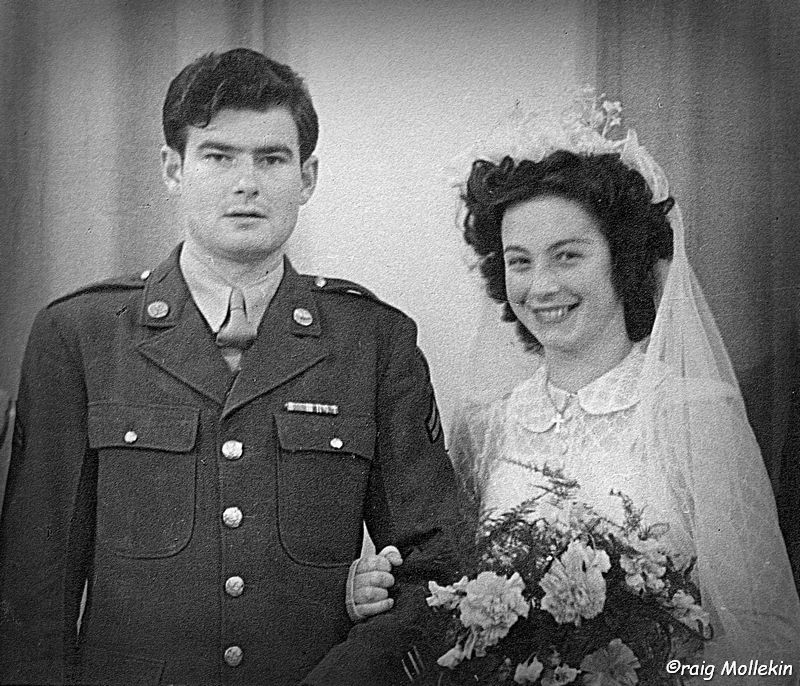
Nineteen days after her nineteenth Birthday, in May 1945, Beryl married Andrew Beulah Kennedy in Saint Alban’s Church, Wickersley. Andrew was a Corporal in the American Air Force, stationed in the local area.

A U.S. AIR FORCE BRIDEGROOM. – Miss Beryl Marjory Mollekin, only daughter of Mr. and Mrs. J. G. Mollekin, of 109 Melciss Road, Wickersley, was married at St. Alban’s Church, Wickersley, last Saturday, to Mr. Andrew B. Kennedy, only son of Mrs. Kennedy, of Hampton, Tennessee, U.S.A., and the late Mr. A. B. Kennedy. The bridegroom is in the U.S. Air Force. The Rev. H. Lee officiated and the hymns sung were ‘O Perfect Love’ and ‘Lead Us, Heavenly Father,’ Mr. S. Briggs the organist. Wearing a gown of white lace, with a net veil and coronet of orange blossom, the bride was given away by her father. She carried a bouquet of pink carnations, sweet peas and maiden-hair fern.

ABK & BMM - Wickersley - 19.05.45 (edited)

Andrew and Beryl

Shortly after their marriage, Beryl and Andrew left England to live in Andrew’s homeland, which was Tennessee, America. This was also an exciting time for my father, as he would receive gifts of items from America that he wouldn’t otherwise have obtained in England. My father was also looking forward to a planned holiday in Tennessee. When Beryl began her journey to America, at the railway station, she gave my father a small, toy, railway engine.

In Tennessee, Beryl became a Bible Teacher.

Telegram (Linda Kennedy's birth)

Telegram announcing Linda’s birth

In September 1946, Beryl gave birth to my cousin, Linda. Beryl sadly passed away four days later.

Coincidentally, Beryl’s great grand aunt, Martha Pinder, died following childbirth 75 years previous in 1871. Both Beryl and Martha had lived at an address, numbered 109. Martha died at 109 Hope Street in Rotherham, whilst Beryl’s last residence in England was 109 Melciss Road, Listerdale, Wickersley.

Telegram (Beryl Mollekin's death)

Telegram announcing Beryl’s death

After Beryl’s death, my grandmother frequently communicated with Linda’s relations in America as she wanted to bring her to England so that she could be raised in Wickersley. It was decided however that Linda would remain in Tennessee. My grandmother passed away just six years later without ever seeing Linda, but my grandfather was finally able to make a trip to see her in 1963.

Below are a couple of newspaper articles pertaining to Beryl’s death.

Saint Elizabeth Hospital, Elizabethton, Tennessee, America (1)

Saint Elizabeth Hospital, Elizabethton, Tennessee, America

CONDOLENCES

Our deepest sympathy with the members of a Wickersley family has been given to them in the sad and sudden loss of their daughter in child birth. Beryl Mollekin, as we knew here, was married here a year last May to Andrew Kennedy, who was in the American Air Force. He was a very nice young man, and they were very happy together. Just after Easter, Beryl went out to America to join him, and last month gave birth to a baby, living only four days after the child was born. Beryl was a member of the Church and a Sunday School teacher. In their deep sorrow, her parents have the consolation of knowing that she was a good girl, and we hope and pray that, though she died so far away from home, they will be granted faith to realise that they may look forward in patience, hope and trust to seeing her again in the eternal home.

30 - Tennessee (Beryl M. Mollekin)

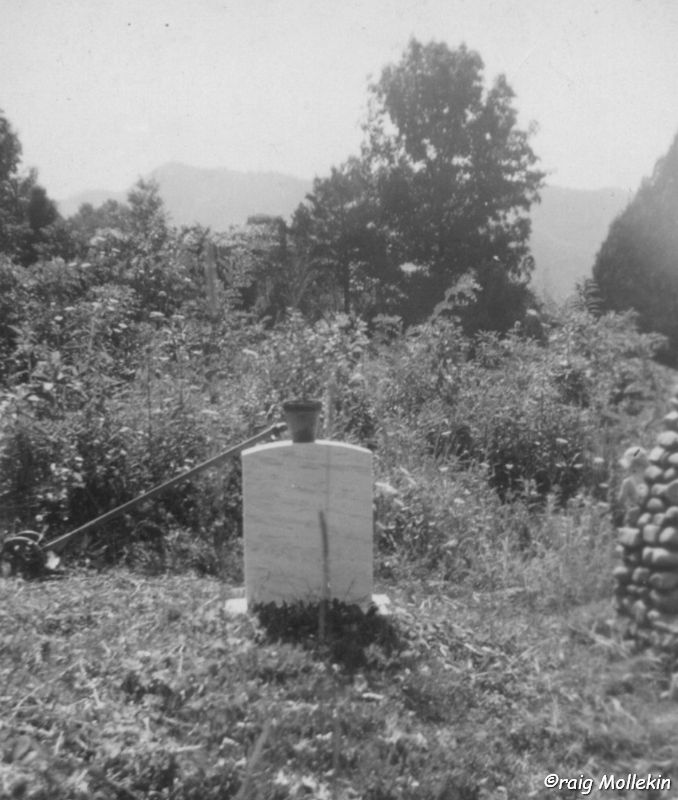
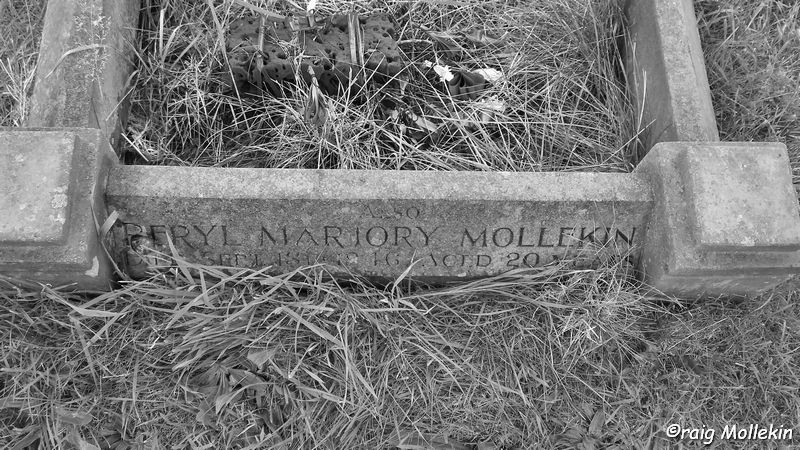
Beryl’s Grave

ELIZABETHTON, Sept. 14. – Mrs. Beryl Mollekin Kennedy, one of Carter country’s war brides and wife of Andrew B. Kennedy, Jr., of Hampton, died at 11:50 a.m. Friday, in St. Elizabeth Hospital, after a brief illness.

A native of Yorkshire England, she was married in England May 19, 1945 and came to this country in April. Her husband, who was stationed with the Eighth Air Corps in England for three and a half years, arriving home last January. The young couple had been making their home with his parents at Hampton. She was a member of the Church of England.

BMM's (left) bible class - America

A pregnant Beryl (left) with her Bible class students

Besides the husband, she is survived by an infant daughter, Linda Kay; parents, Mr. and Mrs. Jack Mollekin; and two brothers, John and Barrie Mollekin, all of England.

Funeral services will be held at 2 p.m. Sunday at Hampton Baptist Church with the Rev. B. N. Canup in charge. Burial will be in the Hall Cemetery.

31 - Saint Alban's Church, Wickersley (Mollekin) - 31.08.17

Saint Alban’s Churchyard, Wickersley

Pallbearers will include Harlan Oakes, Hazen Brumit, Don Hazelwood, Bobby Oakes, Ray Waycaster, Jack Stevens, Sam Young and Charles Baker.

The body will remain at the Roy Hathaway Funeral Home, which is in charge, until 1 p.m. Sunday when it will be taken to the church to lie in state until hour of services.

Although Beryl is buried in Tennessee, she is also remembered on the Mollekin family grave in Saint Alban’s Churchyard, Wickersley.

Herbert Collinson Lowkes

Herbert C. Lowkes

Herbert Lowkes is my second cousin, twice removed and he died as a result of an industrial accident. It is interesting to note that Herbert’s father (William Henry Loukes) preferred the ‘Lowkes’ variation of his surname which consequently has been passed on to all subsequent generations. Below are three newspaper articles regarding Herbert and his unpleasant demise (special thanks to Steve Lowkes for these and the photos).

DYE WORKS EXPLOSION NOVEMBER 10, 1928 – TRAGIC AFFAIR AT BROMBOROUGH – YOUNG PORT SUNLIGHT MAN KILLED – TWO OTHERS SERIOUSLY HURT – SMALL FLAME SEEN TOO LATE

Described by those who were in the vicinity as an explosion that seemed to shake the universe, an accident resulting in the death of one man and serious injuries to two others at the works of Bromborough of Messrs. Brotherton and Co., Ltd., the Mersey Chemical Company on Wednesday.

The injured men were:-

John Williams, of 35, Wood-street, Port Sunlight,
Herbert C.. Lowkes, of 32, Rock-lane-West, Rock Ferry, and
Henry Poole, of 2, Bartlett-street, Wavertree, Liverpool.

All received terrible burns about the face and body. Williams dying from his injuries early on Thursday morning, while the other two men are in the Port Sunlight Hospital in a serious condition.

The accident occurred about 11.30 a.m., in a large room where trays of powdered dye are placed in oven-like containers to dry.

Williams was engaged in one section of the room, his duties including the insertion and withdrawal of the trays, of which there are a number in each “oven.” Lowkes and Poole were, it is understood, engaged at work on a scaffold above, the latter having just returned after fetching a spanner when the tragedy occurred.

Williams had withdrawn all but three of the trays when he noticed, in the one he had just pulled out, a small flame. He shouted, but it was too late, and a terrific explosion occurred. He was flung back for several yards, while Lowkes was, presumably, hurled from the scaffolding to the ground. Poole was thrown down, but jumped up and ran outside, where he collapsed.

Owing to the confined space the dye mixture exploded with extreme violence, and the “oven,” which was made of cast iron a quarter of an inch thick, was smashed to pieces and the back blown out. Pieces of the aluminium trays were also scattered in all directions, wile the windows and skylights of the workroom, which afterwards presented a chaotic scene, were shattered. So great was the force of the explosion that one man standing some distance away had an oilean blown out of his hand.

The “oven,” or frame concerned was one of numerous similar ones in the room and measured about six feet by six feet, while the trays, which are arranged in tiers, are about 2ft. 6Ins. By 2ft. As the dye mixture concerned is, we understand, of a non-ignitable nature, an element of mystery surrounds the cause of the occurrence.

Other men in the room immediately ran to the assistance of the victims of the accident, who, it was seen, were very badly injured. The Port Sunlight Ambulance was telephoned for and the men were conveyed with all speed to the hospital.

It was stated at the hospital yesterday, that if anything, Lowkes and Poole showed a slight improvement, but their condition is still very serious.

Herbert C. Lowkes

INQUEST ADJOURNED.

The inquest on Williams was opened at the New Ferry Police Station yesterday by the West Cheshire Coroner (Mr. J. C. Bate), who sat with a jury. Superintendent Ennion represented the police, and Mr. E. Lloyd appeared on behalf of Messrs. Brotherton’s.

The Coroner said that Williams was employed at Brotherton’s works, at Bromborough, as a process worker. The explosion occurred on Wednesday, and he and the two other men were seriously burnt. Williams was the most badly burnt, and he died as the result of his injuries, while Lowkes and Poole were both in hospital in a serious condition. He only attended to take evidence of identification and adjourn the inquest until Friday next at 10 a.m. It was necessary, he added, in such cases to give notice to the Chief Factories Inspectors at the Home Office, and that had been done.

William Williams, of 35, Wood-street, Port Sunlight, a chemical labourer, employed by Messrs. Lever Bros., Ltd., identified the body as that of his son, who, he said, was twenty three years of age last birthday. Witness saw him in the hospital after the accident and his son was able to speak to him.
The Coroner: Did he make any statement as to what happened?
Witness: Yes.
The Coroner: Perhaps we had not better take this statement now. We will have your evidence at the adjourned inquiry.

ABOUT TO BE MARRIED.

The news of the tragedy and the subsequent death of Mr. Williams caused a painful sensation in the Bromborough and Port Sunlight district. Williams was a popular young man and had many friends in the village. He was formerly a member of the Port Sunlight Boys Brigade, and was a a popular member of the Old Boys’ Association. He was of a quiet and unassuming disposition, but extremely well liked by all with whom he came in contact and widespread sympathy is extended to his parents in their tragic bereavement. He was in the employ of Lever Bros. For some years before joining Brotherton’s staff two years ago. One of his favourite hobbies was bell ringing and he was a ringer at Christ Church, Port Sunlight, for a period. He was born and educated in Port Sunlight, where his father has been employed for many years.

Poignancy is added to the tragedy by the fact that he was engaged to a young lady on the staff of Lever Bros. Catering department, and preparations were already being made for the wedding, which would probably have taken place about Christmas.

Herbert C. Lowkes

CHEMICAL WORKS EXPLOSION.

PORT SUNLIGHT MAN’S DEATH IN HOSPITAL.

Herbert C. Lowkes, aged thirty-three, of 32, Rock-lane West, Rock Ferry, one of the three men injured in the explosion at Messrs. Brothertons’, the Mersey Chemical Works, Bromborough, on November 7th, died in the hospital, Port Sunlight, on Saturday afternoon. He leaves a widow and two children. He is the second victim of the tragedy, the first, John Williams, aged twenty-three, a single man, of Wood-street, Port Sunlight, dying in the hospital on the day of the explosion. The third man, Henry Poole, Bartlett-street, Wavertree, Liverpool, is improving in Port Sunlight hospital.

DYE WORKS EXPLOSION.

Accidental Death was the verdict at the Rock Ferry inquest, yesterday, on Herbert Collinson Lowkes, the second victim of the mystery explosion at Brotherton’s Dyeworks, Bromborough, on November 7.

John Williams, Port Sunlight, died the day after the accident, and Harry Poole, Wavertree, is still in hospital.

Some Youthful Christmas Memories

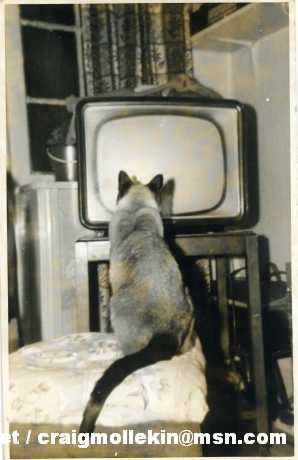
A cat belonging to David Pinder

Below is a piece of writing my father wrote regarding his early memories of Christmas:-

Being not quite five years old when the Second World War commenced, food rationing and the consequences of, namely with regard to confectionery, i.e. sweets and chocolate, provided me with one of my enduring memories of Christmas.  Specifically, that is, of the measures taken to ensure an adequate supply of sweets and chocolate for the festive period.  The weekly ration for one varied from three to four ounces of sweets or chocolate: choice was narrowed down to a bag of toffees or boiled sweets or a bar of chocolate.  Ultimately it involved self discipline by deprivation for a number of weeks before Christmas.  On this subject, one shadowy memory, shrouded in the dim mist of pre-rationing time, involved me inserting a coin into a slot machine that was situated on a railway station’s platform, extracting from the machine a slim bar of a Nestle’s milk chocolate, and then promptly devouring the the aforesaid morsel with great relish.

Another notable memory was of one Christmas I spent with my parents and brother at my uncle and aunt’s house in Mundesley, a village on the Norfolk coast.  The semi-detached house faced onto a minor road, which led to Cromer.  The rear led directly through unkempt paths and scrub to the cliff and what my Uncle David called the German Ocean.  Resident in the house was a large black tom cat named “General”, who seemed to be possessed of remarkable tracking skills.  On my way to the beech or cliff tops he would, without warning, reveal his feline presence behind the next bush or shrub, preening his silky coat with pride.

General was not the only cat in the home.  There were three Siamese as well.  They were graceful animals, with their smooth coats and slim-line physiques.  Also cheekily confident, as one Siamese cat demonstrated by leaping on to the dining table when we were about to start the Christmas dinner, and helping herself from the dish to a potato by spearing it with a dainty paw.

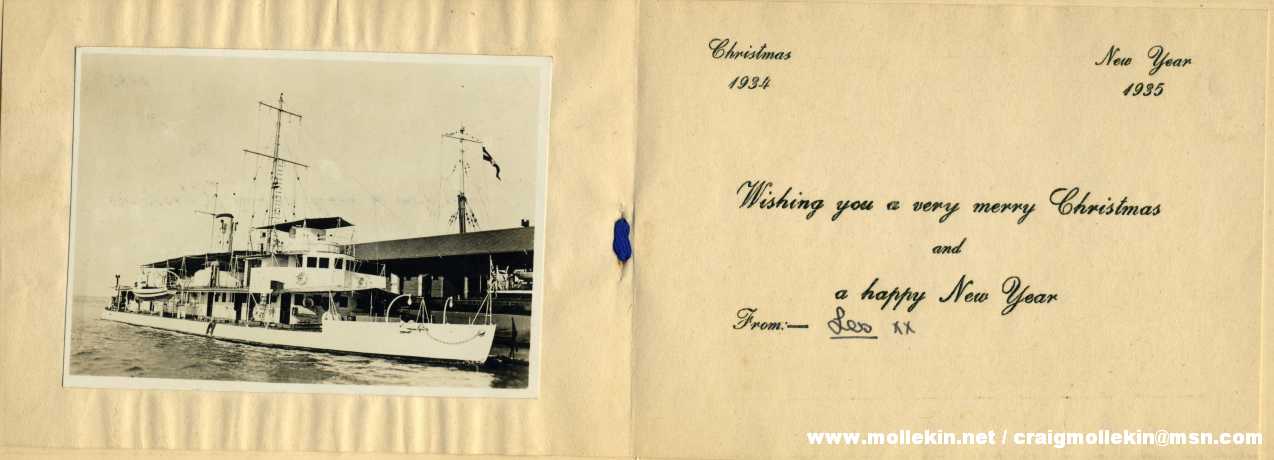
Christmas card from Les Mollekin

On Christmas Day morning, my memory fails me to recall any gifts I may or may not have received.  There was just one gift I can remember. That was a young cat or kitten, given by my uncle and aunt, who came in a cat box.  I was absolutely delighted.  I was thirteen and never had a cat before.  We named her “Striggles” and kept her for four years, before finding her in the gutter in the neighbouring street to home.  We suspected poison, but nothing came from it.  Curiously, the daughter of the next cat we had thirty years after, met with a similar end.  I found her lifeless body next to our car on the house drive, murdered by car thieves.  Again – not proven.

Another memory was Boxing Day in the family home in Listerdale.  I was aged nine or ten; all were sitting at the dining table in the front room, tucking into the ample Christmas fare.  Taking centre stage was my father’s half-brother Leslie, resplendent in his naval uniform, fresh from the ship, the destroyer H.M.S Dido.

First Visit To Millmoor

Rotherham United

Below is a piece of writing my father wrote regarding his first visit to Millmoor, Rotherham:-

It was one morning, in the depths of winter, in 1944.  On a Saturday morning to be precise, when there was no school to interfere with my leisure pursuits.  After partaking of my usual sumptuous breakfast repast, i.e. Kellogg’s Shredded Wheat followed by tomato drip on fried bread, I turned my attention to creative matters, specifically to read ‘Kidnapped’ by Robert Louis Stevenson.

While I was engaged in this pleasurable task, my attention was momentarily distracted to a bowl of apples, freshly gathered from the local orchard.  Not bothering to obtain my mother’s permission, I greedily detached the largest, reddest orb from the pile.  Eagerly crunching the delicious fruit, my attention was once again distracted by the thought of a niggling chore, which I needed to complete for nature study at school.  Grabbing a pen from the sideboard, I launched the necessary task.

After completing the list for the nature study with a sigh of relief I turned back to my book, only to be interrupted by my dad, brandishing a gigantic read and white scarf, previously owned by my granddad.  The colours on the scarf were of Rotherham United Football Team.

“Here you are,” my dad passed my coat and the scarf, “we are going to the match.”

Schooling In The War Years

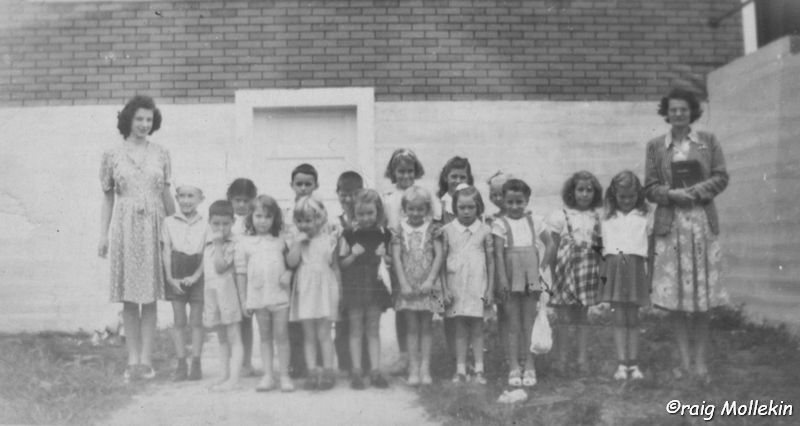
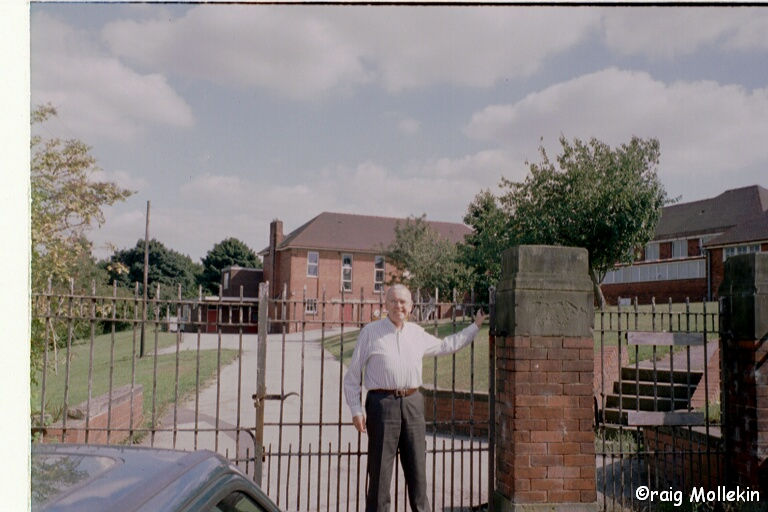
Dalton & Listerdale Infant & Junior School

Below is a piece of writing my father wrote regarding his early schooling years in Wickersley, South Yorkshire:-

My early years of life were spent in growing up in a semi-rural, private housing estate, about three miles east of Rotherham, an industrial town in the bottom of a valley.

The whole of my formative education took place at Dalton and Listerdale School, in the period of time which is closely parallel to the duration of the Second World War.

If this period of strife and conflict was indicative of this particular time, it was mirrored by my battles and skirmishes with some of my fellow school mates and authority in the persona of the Head Teacher.

With the onset of war came rationing of clothes, food, and associated wants and unfulfilled needs and desires.

Some of my earliest memories were of school. I must have been an early reader, as I can remember helping other children to read.

A sturdy climbing frame, built into the wall in the infants playground, was a particular favourite. As I made my solitary progress around the labyrinth of steps, ladders and tunnels, my imagination conjured up images of heroic deeds accomplished by past, long dead warriors. For a brief time, I was in heaven!

The teachers were quite a diverse collection of individuals. Some time served professionals, some of uncertain age and qualification, brought back into service by war demand. Some not loath to use ruler or fist, when their patience ran out.

One teacher, a choleric Welshman with the predictable name of Morgan was a truly alarming figure. At best a genial, kind hearted man, able to instill learning into his charges, at worst, violent and subjected to rage. I recall him beating a friend of mine, a mild mannered boy, around the classroom, because the culprit, had the temerity to draw a line without a ruler.

Miss Hiscock, a gentle, a self effacing, late middle aged lady, left no enduring memories.

Miss Ward, 35ish, suave and efficient poise, commanded whole hearted respect from the toughest of boys.

And Miss Bracegirdle, quite young, with sturdy build and eager manner. Nothing girlish, with her and her “jolly hockey sticks” approach.

But the memory invoked by the Headmaster remains permanently engraved on my conscious. With his misplaced humour and malicious sarcasm, meant his teaching methods were fatally flawed. For years the recital of multiplication tables gave me problems, as a result of his teaching methods.

Ironically, later, when we took our two eldest children to Dalton and Listerdale for their education, Mr. Lake was still incumbent at the school, and they left at the age of eleven, with no noticeable adverse, effect on their psyche!

For my cousin Dorothy, who was in the same class, conditions were more pleasant.

In one lesson where I failed to give a satisfactory rendition of the nine times table, Mr. Lake, with fiendish relish, seized the chance to compare my abject failure to my cousin’s obvious, intellectual superiority.

Needless to say, cousin Dorothy passed the intelligence quotient at eleven and I failed.

The daily routine started in the school’s main hall. Proceedings got underway with a prayer, followed by Miss Ward accompanying the pupils, on the piano. Traditional songs were sung, some with rousing air such as, “The British Grenadiers” and the “Men of Harlech” then to the lifting refrain of the “Lincolnshire Poacher” and “John Peel” to the hauntingly score of the “Ash Grove”.

Then the Head Teacher addressed us on points of order and interest, such as, allowing the girl whose father was a sailor, to show us a bunch of bananas, or naming pupils who had transgressed the school’s good conduct reputation by their obnoxious behaviour to some one or something, usually out of the school’s bounds.

The assembly was brought to a close by the singing of hymns and the saying of the Lord’s Prayer.

The mid-day meal was brought from outside kitchens and was served in the main hall. The cost of the meal was half a crown, or 12.5p, a week.

Prunes and custard was a regular feature, and flat sponge puddings in a large tins, tasted of salt on the underneath.

There was infrequent dance lessons which I enjoyed. I learnt the “Saint Bernard” Waltz, from that.

There were no excursions, educational or otherwise, but with the school being juxtaposed with the wood, there were occasional forays with the class on nature walks.

There was plenty of recreational space at the front and back, most of it grass covered. In the warmer weather most of the children played on the grass, often involving the boys wrestling. There was one incident, where boys wrestling on the grass started to fight. I was involved. I cannot remember the reason for the dispute, just that I was very angry. The boy I was fighting was, older, bigger and enormously tall! I mounted a ferocious assault, throwing my punches in a frenzy of hate, all of which he blocked, with his massive arms. Finally I stopped, exhausted. My opponent, then, disdainfully, threw me down, sat on my chest and spat in my face!

Popular games were marbles and, in season, conker playing. Horse chestnuts were in abundance in the adjacent woods. Of course, collecting of the great tree’s nuts was great fun.

Most food was rationed. Even so, we never went hungry. Cereals: Weetabix, Corn Flakes and Shredded Wheat were usually available sometimes depending on supply or the number of food coupons in the ration books. A favourite for breakfast was tomato dunk. My granny fried canned tomatoes, and passed slice after slice to me and my brother.

For tea, we had, sometimes, a boiled egg and slice after slice of bread and margarine, thinly spread with jam.

There was virtually no evidence of sweets, biscuits or such. I recall one occasion when I was finishing off the remains of an apple, when a school mate said “gis your cob”. Even though they were not rationed.

“Crisps” were in short supply. Favourite place to get some, was in the local pub, if you dared to risk going in.

On rare occasions, my mother used to bring Walls ice cream, wrapped in newspaper, from town. To this day, I still prefer to eat ice cream, preferably “Walls”, nearly melted.

On Saturdays I did the week’s big shopping for the weekend. You were registered with a butcher, who took care of your coupons, and in return provided you with so much meat. My mother designated the type, and I chose the joint.

For a while I walked round to the shops. Till one day I noticed my dad’s “push-bike” in the coal place. I did not own a bike, but I learned at eight to ride. This was a highly traumatic experience. My brother purloined a dubious specimen and set me off on a steep hill. Careering wildly down the hill without much control, I crashed into a hedge at the bottom. But from that day, I could ride.

With the village being in the country, it was surrounded by woods and farmlands. In consequence, crops of of potatoes, peas, turnips, as well as the usual wheat corn and such.

When I was aged eight, I went out, one day, with my brother and two friends, and we decided to get a turnip. Of course the turnip was in a farmer’s field. We were just about to eat the turnip, after skinning it with a sharp knife, when the farmer, Mr. Burden came up to us. He said he was going to report us to the police. Which he duly did. With the result that the village “Bobbie” Mr. Baron knocked at our back door, after a few weeks, investigating the alleged crime. He came again, and again, and again. When I used to see him coming, I made a hasty retreat, to the back garden, where we kept two rabbits. Anyway, the Policeman’s visits, came to an end, when my brother received summons to attend the West Riding County Court. He was found guilty of the charge of stealing a turnip from Burden. Because of his age, eleven, he escaped more severe punishment. Later on, in life, he was in court for a minor traffic offence, and the “turnip” was on his criminal record. I did not have to attend, because of my age.

A common practice was to keep livestock, to help with the ration. We had rabbits, which were “Flemish Giants”, and were of gigantic proportions. When I lifted them out from the hutch, after biting my fingers, they often managed to escape. Their usual goal was the vegetable plot, where their voracious nibbling reduced the salad crop to a minimum.

Like most kids I loved to read comics, but they were in short supply. You were very lucky to get a “Dandy” or “Beano” at the newsagents, you had to be early. So we had to exchange old comics. It was a common experience, to answer the door to one of the friends, who wanted to “swop” his comics for yours.

There was no T.V., so the “wireless” was the major entertainment in the home. The “pictures” were favourite. The local chapel showed “silents”, two hours for 6d. Further afield, in Rotherham you had a choice of six picture houses and a theatre.

With my father working on the L.M.S. Railway, we had cheap travel on holiday. We went to relations in Crail, Scotland, travelling for about thirteen hours.

Our back garden led directly onto waste land, where a saw mill’s shavings were dumped. We used to jump from quite a height into the shavings. It was quite a risk, because sometimes, if the shavings were freshly dumped, it was red hot in the centre.

There was a company working a stone quarry, which closed down early on in my life. The stone was soft sandstone. Later we came across a number of large storage buildings with a vast number of carvings in the stone. It was wondrous behold. Of course they were carvings for graves etc.

I have no recollection of any adult taking me to school; apart from one occasion, on a half day holiday, for eating pancakes on Shrove Tuesday; when my father noticed me meandering, forgetfully, on the track, and carried me home on the crossbar of his bike.

I had two main routes to school, which was a mile away. One was the “woodway” from the bottom of the Listerdale Estate and top of the woods. The other was the “roadway”, the main road from Listerdale to the Brecks. Both routes had their attractions but the roadway gave the chance to see heavy “Churchill” tanks and other military hardware passing the school. Another attraction on this route was the ornamental pond, in the grounds of Lister’s ‘Castle’. This was full of marine, wildlife, which we, often, observed from the bank side.

Lister’s ‘Castle’ was a pseudo semi-castellated edifice; which to us looked very grand; built, in the 1930’s by housing magnate, Joe. Lister.

A mandatory piece of equipment which all school children must carry to and from school was the gas mask which was designed to protect from poisonous gases dropped in an air attack.

Special test centres were set up at school, where the efficacy of the masks were assessed by using school children in simulated gas attack conditions.

There was an air raid shelter built at school, where we had practice drill.

When the air raid warning sounded, when we were at home, it did not mean a dash for the local shelter, because my mother decreed that we were safer at home.

James B. Mollekin
Swinton
23 March 1998

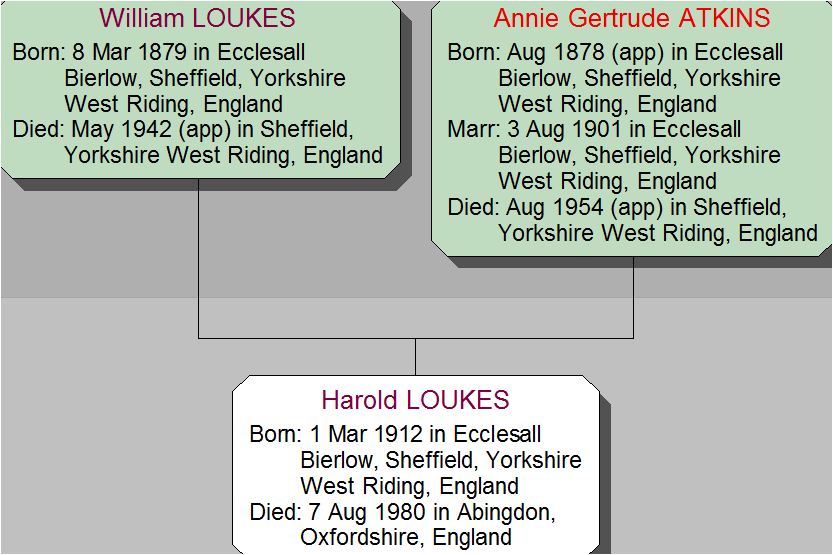
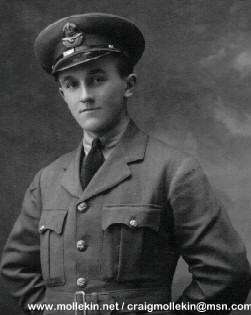
Harold Loukes

Harold Loukes

Harold Loukes is my fourth cousin, twice removed and below are his obituaries.

THE FRIEND – 12th SEPTEMBER 1980

Friends in Oxford, as elsewhere in the country, have suffered a great loss in the death of Harold Loukes, on August 7, at the age of 68. He had retired only a year ago and, though for most of that time he was aware that he had only a limited time to live, he continued his faithful service to the Society.

Harold Loukes was born and educated in Sheffield, and at JesusCollege, Oxford, where he took a First in English, followed by the Diploma in Education. Coming up to Oxford as a Methodist, he came in touch with Friends through Henry Gillet and became a member of the Society while still a student.

After Oxford, Harold went to St Stephen’s College, Delhi as a lecturer in English, and in 1937 he married Mary Linsell. He stayed in India until 1945, becoming Headmaster of the NewSchool at Calcutta and Darjeeling. Harold and Mary then returned to Britain with three sons. A daughter was born later- Harold gained experience at Oundle, LeightonPark and ThorneGrammar School before becoming lecturer (later Reader) in education at the Oxford Department of Education. There he taught for 30 years, entering fully into the ambitions and ideals of his students, and delighting many generations with his penetrating, experienced and witty lectures.

Throughout his many years in Oxford Harold was a loyal member of his meeting. He took a particular interest in Young Friends, and was for many years the ‘Senior Member’ (required by university regulations of the Oxford University Friends Society. Young Friends appreciated his combination of scholarship, spiritual depth, frankness and humility, and his keen sense of humour. The same qualities, together with his deep concern for the meeting, made him an outstanding elder. His ministry had a memorable beauty and calm, his spiritual insight was expressed in lovely and sometimes striking phrases. This was perhaps especially felt, when he spoke, as he often did, of the nature of Quaker worship, which he described as ‘ a living moment, a loving silence; the sound of the sea, the light behind the hills’. Meeting for worship, he told us in his last spoken message to Oxford Friends ‘is meant to be living, immediate, open to insight and interpretation. But there is a right ordering in the love of God, which we obey by quiet sensitivity and the holding in our tendered imagination of the needs of the other.’

Harold said that he found it a good discipline to think things out on paper. Throughout the postwar years that discipline has enriched the life of the Society of Friends and beyond with a series of books, study outlines, essays and articles. Apart from his extensive writings on the religious and other aspects of education, his books on

Quakerism, must have been instrumental in drawing many, especially younger readers, into the fellowship of the Society, and in deepening the beliefs of those born into it. He gave the 1959 Swarthmore Lecture, entitled The Castle and the Field, and the 1963 Rufus Jones Lecture in Philadelphia. He contributed countless reviews and articles to THE FRIEND, and was chairman of the Friends Home Service Committee from 1969 to 1973.

By careful planning Harold made full use of his life. Apart from his devotion to his family he had many public commitments. He was a JP for many years, and from 1975 to 1980 was chairman of Abingdon magistrates. He had been a governor of both maintained and independent schools and a member of Oxford Education Committee. He also had many friends and contacts in other churches.

Though he lived a very full life, Harold had time for friendship, and taking an interest in people. With all his experience he was a quiet, modest man. We loved him for the depth of his faith, but we loved also his jokes and the twinkle in his eye. We offer our deepest sympathy to his wife, Mary, and their family.

THE TIMES – 3RD SEPTEMBER 1980 – OBITUARIES – HAROLD LOUKES

Harold Loukes, who died on August 7, was educated at the Central Secondary School, Sheffield and at Jesus College, Oxford, where he gained a First Class in the Honours School of English Language and Literature. After graduating in 1934 he spent 10 years in India teaching in the University of Delhi and later serving as Headmaster of the New School, Darjeeling.

He returned to this country in 1945 and after four years as a schoolmaster he was appointed in 1949 to a lectureship in the Oxford University Department of Education and, in 1951, he became University Reader in Education.

During his 30 years in the Department he contrived to sustain three successful careers: his published works furnish adequate evidence of his capacity for competent empirical research and meticulous scholarship; he involved himself in civic affairs, as a school governor, a member of the Oxford City Education Committee and as a Justice of the Peace; but it is for his effectiveness as a teacher that he will be chiefly and gratefully remembered.

Michael Rodney Tyzack

Michael R. Tyzack

Michael Tyzack is my sixth cousin and below is his obituary.

THE INDEPENDENT – THURSDAY 19TH APRIL 2007 – OBITUARIES – MICHAEL TYZACK

Painter and jazz trumpeter who exchanged Sheffield and London for Charleston, South Carolina.

Michael Rodney Tyzack, painter and teacher: born Sheffield, Yorkshire 3 August 1933; married 1959 Patricia Burgin (one son, one daughter; marriage dissolved 1990), 1993 Anne Carson; died John’s Island, South Carolina 11 February 2007.

Michael Tyzack was one of the most distinguished British abstract painters to have settled in the United States in the last half-century. He went to teach and became a revered mentor for many young artists, telling them that ‘without risk, there is no serious painting’.

Initially Tyzack did not cross the Atlantic to settle, although he had for some time hankered to visit the country whose artists had made such an impact in Europe after the Second World War. When in 1971 he was invited to become visiting artist to the School of Art and Art History at the University of Iowa it was for just two semesters. This was gradually extended until he remained five years before moving to the School of the Arts, College of Charleston, in South Carolina, where he remained as Professor of Fine Arts.

Tyzack said that the transformative event in his career was winning first prize at the fifth John Moores Liverpool Exhibition in 1965, where the jury chairman was the influential American critic Clement Greenberg. Tyzack’s prize picture, Alesso B, was a seductively coloured acrylic on canvas. Although apparently completely abstract, it alluded in its title to the Renaissance painter Alesso Baldovinetti’s Portrait of a Lady in Yellow, in the National Gallery, a reproduction of which was pinned to Tyzack’s studio wall.

Robert Hughes and Norbert Lynton were among other critics to praise Tyzack’s work, Lynton supporting him in his first one-man show at the Axiom Gallery, London, in 1966. The Walker Art Gallery, Liverpool, acquired Alesso B. Asked how he would like viewers to respond to it, Tyzack answered simply: ‘I hope it gives them pleasure.’

Michael Tyzack was born in Sheffield in 1933, only child of Vincent Tyzack, a cutler, and his civil servant wife, Claire. They were proud and encouraging when Mike was enrolled at the Sheffield College of Art and Crafts, then achieved a place at the London University Slade School of Fine Art, gaining his fine art diploma in 1955.

On vacation in Sheffield and lacking a studio, Tyzack heard that the Sitwells’ family seat Renishaw Hall had abundant rooms and outbuildings. He asked for somewhere to paint, and a space was granted. A bonus, Tyzack’s first wife Patzy recalls, was the butler bringing a cup of tea on a tray. More daunting was a visit from the poetess Dame Edith, demanding: ‘Young man, what are you doing here?’

Tyzack had influential teachers at the Slade, among them the Slade Professor William Coldstream, Lucian Freud and William Townsend. In 1956, Tyzack won a French Government Scholarship in Fine Art and left for Paris, later spending time in Menton. Pictures painted in the south showed the influence of Cézanne and a tendency towards abstraction.

While at the Slade Tyzack had met British abstractionists such as Patrick Heron and William Scott and in the move from realism to abstraction he followed the course taken years before by another Slade teacher, Victor Pasmore.

When he returned to England after his stay in France, Tyzack spent several months working as a professional jazz trumpeter. Jazz had been a passion from his youth in Sheffield. He played in bands there and at the Slade, and after marriage in 1959 with his wife visited the London clubs to hear such admired bands as those of Ken Colyer and Humphrey Lyttelton. For two years Tyzack played with the Oriole Jazz Band, a Bristol group that recorded. ‘For Mike it was a serious business,’ says Patzy. ‘He would listen, whereas I thought we were going to dance and leap about.’

As a trumpeter Tyzack admired Louis Armstrong and Bix Beiderbecke, but his jazz interests were catholic. The music informed his painted work, as in the acrylic-on-cotton-duck picture Blue Monk (1982), finished as Tyzack heard of the pianist Thelonius Monk’s death. The sombre blue work reminds us that a psychological, emotional significance underlies its apparent abstraction.

Anyone who knows Tyzack’s mature geometrical abstracts could appreciate his respect for the work of such artists as Malevich and Mondrian. More surprising might be his reverence for those natural celebrators Matisse, especially, and Monet. Tyzack spent his 30th birthday seeking admission to Monet’s garden at Giverny, only to be turned away because it was closed for renovations. Patzy recalls: So he climbed over a wall and lay in the garden among the wistaria and rambling roses drinking his large bottle of champagne. The photographs he took are probably among the last before the renovations took place.

While teaching at such institutions as Cardiff and Hornsey colleges of art, Tyzack continued laying the foundations of a prolific exhibiting career, which would include over 50 British and overseas group show appearances. Among them were ‘Painting Towards Environment’ (Bear Lane Gallery, Oxford, with an Arts Council tour, 1964), ‘New Shapes of Colour’ (Stedlijk Museum, Amsterdam, with European tour, 1966) and the controversial ‘Documenta 4’ (Kassel, 1968). In addition, he had over 20 solo exhibitions.

His first solo show after moving to the US was at the Corcoran Gallery of Art in Washington in 1973 and in 1978 he was given a retrospective at the Frances Aronson Gallery in Atlanta, Georgia. The move to Iowa in 1971 affected the way that Tyzack saw the world, witness his acrylic-on-cotton-duck Nocturne (1972), in the collection of the Indianapolis Museum of Art. Although abstract, it is essentially lyrical and pastoral.

Having spent most of my creative life in dense, crowded urban environments, I seemed to experience the open expansiveness of the sky, as seen for the first time, in Iowa,’ said Tyzack. ‘This spatial expansiveness became incorporated in my paintings.’ He believed that the special quality of light in the Charleston area ‘informs my colour choice almost as much as my emotions’.

A serious car accident in the 1980s led to long and painful months, stretching into years of slow recovery. When he returned to his art, Tyzack exhibited a series of Small Nocturnes, drawings in mixed media on paper. In 1989 he went back to his diamond motif, which had begun with his painting Kremlin (1961). In 2001, it dominated his impressive solo exhibition at the Halsey Gallery, Simons Center for the Arts, in Charleston. ‘Appropriate to the Moment’, a title appropriated from the teachings of Zen Buddhism, comprised 18 works completed between 1989 and 2001. Tyzack’s colour variations were so subtle that sometimes they did not seem to be there. ‘Pessimists see an absence of colour, optimists the potential presence of colour,’ he said.

By now, Tyzack had work in three dozen international public collections, including the Tate Gallery, the Arts Council of Great Britain, the Victoria and Albert Museum, the Gallery of Ontario in Toronto, the Kunstmuseum in Berne, and the Arts Commission of South Carolina, Columbia.

Tyzack retired as head of the College of Charleston’s art department in 2005, when he became Emeritus Professor of Painting. He retained a studio on the campus and continued to teach, where his lust for life, generosity, quintessential Britishness, dry wit and aphorisms were appreciated. When a visiting former student expressed disappointment with graduate school compared with what had gone before, Tyzack wryly commented: ‘You thought it would be Nirvana, but it was bananas.’

Until a few weeks before his death, Tyzack continued to play jazz with his Dixieland band Authenticity. On trips to England he would jam with his guitarist son Ben, who has a recording group, the Spikedrivers.

Frank Decent Slingsby

Frank D. Slingsby

Frank Slingsby is my first cousin, twice removed. He died in October 1979 and below is his obituary.

THE MAN WHO DIDN’T WANT TO RETIRE

From a four shilling a week apprentice fitter to chairman of the family company that was the work record of Hull businessman Mr Frank D. Slingsby, who died yesterday at the age of 80.

He was chairman of G. and A. E. Slingsby Ltd. engineers, tube and valve specialists, of Cleveland Street, and had a work record stretching 59 years with the family firm.

Mr Slingsby took control of the firm in 1934 on the death of his father, and became chairman and joint managing director with his cousin when the business was incorporated in 1952.

During the post war years, he also built up a dairy herd of Jersey cattle, and was later joined by his two sons in the family enterprise of F. D. Slingsby and Sons based at Rowlston and Gransmoor.

Mr Slingsby, who lived at Willow Garth Rolston, never considered retiring, and attended his office until April this year.

He is survived by his two sons, Mr David Slingsby, present managing director of the engineering company, and Mr Jeffrey Slingsby, who runs the farming side of the enterprise.